A personal perspective
Why I speak out against some ‘famous’ people.
Even when it hurts me.
I know what it is like to need help and struggle to find it. I also know that being grateful for the people who recognise withdrawal should not mean staying silent when their support falls short.

I did not arrive here as a detached observer.
I came to this work through my own experience of benzodiazepine and SSRI withdrawal. I had to find answers while I was suffering, when understanding and practical help were not nearly as available as they should have been. My story explains that journey in more detail.
In my experience, people harmed by psychiatric medication are too often left struggling to find informed care, recognition and support. It can feel as though we are standing outside the medical system, cap in hand, asking for help that should already be available.
I am not claiming every other area of medicine gets everything right. Dismissal happens elsewhere too. But from inside withdrawal, the lack of somewhere reliable to turn can feel especially cruel. You are already dealing with the symptoms. You should not also have to campaign for them to be taken seriously.
Like what feels to me like 99% of people who finish tapering, I could have left the withdrawal world behind and got on with my life once I was better. I would not blame anyone for making that choice. After everything withdrawal takes from you, wanting your life back is entirely understandable. But I could not simply walk away.
What stayed with me was the feeling that some of the people supposedly helping us and challenging the system were, in my experience, reproducing the very things I resented about it: rigid answers, resistance to questions and dismissal when someone challenged the accepted approach. Being outside the medical establishment does not automatically make a community different from it.
I want to be blunt about what that cost me. All the way through my taper I was not only fighting the symptoms, I was protecting myself. Not only from doctors who did not understand withdrawal, but from people inside the community that exists to fight for that understanding. In my opinion, some of what they did set me back. Being banned, ignored or talked down to when you are already frightened and barely sleeping is not a small thing. It takes the last of your energy, and it makes you doubt yourself at exactly the moment you need to trust what your own body is telling you.
That is the part I still cannot accept. These are people who know what suffering is, or at least some of them do. And still the ego is the size of a mountain. Ask a legitimate question about the advice being handed out, or point out that it contradicts their own material, and you can be removed, blocked or belittled for it. That frightened me more than anything a doctor ever said to me, because these were supposed to be the people on our side.
Here is what still arrives in my inbox. People tell me they were handed a water taper with a fixed amount taken out every day, by coaches whose names are well known in this world, and that they got sicker the further down they went. I cannot show you those plans. They were given to me in confidence and the people who sent them do not want to be named, so take it for what it is: what I was told, not something I can prove.
What I can prove is the contradiction. Take the same amount out every time and every cut is a bigger share of what is left. That is precisely what the hyperbolic guidance this whole field leans on says not to do. That guidance is published, it is quoted everywhere, and the people handing out fixed-amount plans are not outsiders to it. When I raised this, nobody said “let us check”. I was treated as a competitor.
That is what made me angry enough to write all of this. I was not selling a rival product. I had built a free spreadsheet, I gave it away, and for years senior people in this community would not even look at it. Mark Horowitz was one of them.
And then there is Barbara Connolly. I promoted that spreadsheet inside her group for a year — a free gift to her taper community. She had it assessed by all of her moderators. She had me record the instructions again, and again, and again, to satisfy her, as though I worked for her. I did it, every time, because I wanted it to help her members.
Then we had an argument. And she removed me from the group and stopped promoting the spreadsheet. In my opinion she damaged her own group to protect her ego — her members lost a free tool that had already been checked by her own moderators, and they lost it because of a disagreement with me, not because anything was wrong with it.
And it is not only the withdrawal world. When I finally found the CBD oil that helped me get off the drug, the doctor I was seeing would not prescribe that one, and I never got a clinical reason I could follow. I do not know his reasons and I am not accusing him of anything. But it left me asking how much of the advice I was given, by clinicians and by advocates alike, had something to do with who supplies what.
And there was something else I could not ignore: in my own recovery, I felt I made much faster progress once I found the supports that helped me, even when seeking them meant going against the dogma I had encountered. That is my experience, not a promise that the same things will work for somebody else. But it made it impossible for me to accept that frightened people should be discouraged from asking questions or exploring what might help them.
That is why I am here. I want to offer the kind of time, attention and practical support I struggled to find, not simply another confident voice telling someone what to do.
Being on our side should mean something.
I expect a dramatically higher standard from the lived-experience community. We know what it feels like to be dismissed. We should not reproduce that same defensiveness, hierarchy and disregard under a more sympathetic name.
I am grateful to people who have helped bring withdrawal into the conversation. Their work can be valuable and still deserve scrutiny. Having suffered does not make any of us beyond criticism. Neither does writing a book, building a following or charging a premium price.
People have described receiving fixed-reduction water-taper plans from established coaches. Putting a taper in water does not change the arithmetic: the same fixed reduction becomes a progressively larger percentage of the remaining dose. A method deserves an explanation, not immunity from questions because somebody well known recommends it.
We should not have to choose between being abandoned and being unquestioning.
I understand that criticising other services can look like taking shots at the competition. I do not blame you for questioning it. Had I not lived through what I experienced, I might have felt exactly the same.
I also have a service to offer, so you are entitled to scrutinise my position. I am not asking you to trust me because I criticise someone else. Read the reasoning. Ask me difficult questions. Judge what I do by the same standards.
The experiences behind my standards.
The people discussed here are only some of those I have had difficulties with. This is not a verdict on everyone in the withdrawal field. Just as importantly, I have had wonderful experiences with others, including well-known advocates and smaller coaches who cooperate with me.
I have found generosity and a willingness to work together among both prominent people in this field and less well-known coaches. Those experiences deserve recognition too, without naming anyone or implying their endorsement of this article. My objection is not to someone being famous, or to someone else offering support. It is to the specific conduct and guidance I describe here.
How this section works
Tap a name below to open that account.
One account shows at a time, with the screenshots and records behind it. The names run from the people I am grateful to, through mixed experiences, to the experiences where I believe support fell short.
Heather Ashton.
This story contains gratitude as well as anger. There are people whose work gave me hope, helped me understand what was happening, or simply gave me strength to keep going. Admiration does not require believing someone is right about everything. Nor does naming them here imply that they endorse me or this article.
Professor Heather Ashton deserves an enormous place in that gratitude. Her withdrawal-clinic work and the Ashton Manual gave people a practical resource when informed help was desperately hard to find. I can question individual recommendations without losing sight of what that contribution meant.
The manual is now decades old. I do not regard every detail as accurate or sufficient for today's practice, and some people find its example schedules much too fast. To be fair to Ashton, she explicitly said schedules should be tailored to individual needs. I respect her as a pioneer working with the knowledge and practical tools of her time, not as someone whose tables must remain untouched forever.
Peter Smith once told me that people used to powder a tablet, arrange it in a line and divide it by centimetres and millimetres. Yes, that was the method he described to me. I am recounting his explanation, not presenting it as a verified history or a method to copy: the length of a line of powder does not reliably establish its drug content.
Today, inexpensive digital milligram scales and calculation tools can make some of the practical work much easier. That greater accessibility matters to me. But a display reading to 0.001 g is not a guarantee of accuracy at that level, as scale manufacturers themselves explain. Tablet weight is not the same as active-drug weight, and not every tablet can safely be crushed.
A pharmacist can help establish whether a proposed preparation method is suitable. I can help you work through this too: by understanding exactly which medication and formulation you are taking, helping you find the manufacturer's official information, and helping you get answers through the appropriate professional channels. You do not have to figure it all out alone. My aim is to help you make practical use of better tools, understand what the measurements mean and find a suitable way forward.
Geraldine Burns.
Geraldine Burns was instrumental in getting Professor Heather Ashton to write the Ashton Manual. The Alliance for Benzodiazepine Best Practices explicitly credits her with that role, as does World Benzodiazepine Awareness Day. In Ashton's own 2001 foreword, on page 9 of this PDF, Ashton explains that the chapters were written by request in 1999 and credits Geraldine, alongside Rand M Bard, Ray Nimmo and Carol Packer, for producing and distributing the booklet and making it available worldwide.
I also admire her work with Representative Paul McMurtry on benzodiazepine legislation in Massachusetts. But my appreciation is personal too. We have had many conversations, and she has given me a great deal of encouragement and help. I have found her wonderfully approachable, kind and generous. I honestly wish she were a coach as well. She is an example of how much it matters when someone with that experience makes time for another person.
Mark Horowitz.
Strange, I know. I have a great deal of criticism of this man, and it has a whole panel of its own in this article. I decided to put him in both lists rather than file him under mixed experiences, because in his case the two things need to be kept apart, not blended into a polite average. My own experience with him was genuinely bad. And still: the noise he made about hyperbolic tapering matters, and it reached rooms I will never get into, even if he ignores me and the errors I found in his book.
Mark Horowitz's work matters too. The existence of the Maudsley Deprescribing Guidelines, co-authored with David Taylor, is important. In Australia, its recognition by the RACGP as an accepted clinical resource is documented in a South Australian government webinar summary. That is a concrete sign of progress in professional recognition and education, not proof that practice has changed everywhere or that the book alone caused every improvement.
I want to be precise about what I am not crediting. I remain deeply dissatisfied with aspects of the tables. With CBD filed away as unwise next to addictive substances, by an author who later told a public webinar that he could not say he was very familiar with those products, and with supplements getting almost nothing. And with what I consider pseudo-science in the benzodiazepine chapter: every benzodiazepine receptor-occupancy curve in that book traces back to a single 1991 PET study in non-human primates, stretched to cover alprazolam, clonazepam, lorazepam and all the rest through equivalency tables. We are not baboons. Add the other problems I found, and in my opinion this book is not merely imperfect, it is dangerous. I set all of it out, page by page, in my review.
But guidance that recognises the need for a slower, individualised withdrawal process is, in my view, a major improvement over treating “four weeks and you're off” as a universal answer. Both things can be true: this work has value, and it still does not give everyone what they need.
That brings me back to the picture I cannot get out of my head: the poor Victorian child in torn clothes, standing outside with his cap in his hand, begging for anything at all, and getting something, but not really a lot. Finally receiving something matters. But it is maddening that people can still be expected to be grateful for less than the care they actually need. Progress deserves recognition. It should not become an excuse to stop asking for better.
Podcasters and voices with lived experience.
I really enjoyed listening to coach David Powers and to D E Foster's Benzo Free Podcast. Listening while driving gave me strength. Hearing a voice that understood helped me feel less alone.
Angie Peacock is another person I have really enjoyed listening to. I consider Medicating Normal, the documentary in which she shares her story, an important film. What I know and appreciate personally is her voice and the experience she has shared.
There are more people I follow online and on YouTube, from both the antidepressant-harm and benzodiazepine communities, than I could possibly list here. Some share their views on things they have found helpful. Many simply talk about their healing and what they have lived through. That matters enormously when you find yourself lonely in this experience. So do the everyday people who upload their testimonials and recovery stories. Hearing someone describe a struggle you recognise, and seeing them find a way forward, can mean so much.
But not every story I followed had reached a happy ending. Sometimes I only discovered someone's video diary years after they had started posting. Watching their updates, I could see the “windows and waves”: periods of relief followed by renewed suffering, with some people still struggling long afterwards. From what they described, I believe inadequate tapering contributed to prolonged suffering for some of them. Those stories stayed with me too. They are another reason I wanted to do this work: I wanted people to have better support and better ways to taper, before they found themselves going through an ordeal like that.
The friends from the journey.
Most importantly, there were the friends who helped me through my clonazepam tapering ordeal. They kept me afloat mentally and emotionally during one of the hardest periods of my life. I will forever cherish those friendships and what those people did for me. Some are still my friends to this day, even though we live on different continents.
There are others too, including smaller coaches who cooperate with me and people who have shown real generosity. I do not want their contribution to disappear behind the difficult experiences. This field contains people I genuinely admire.
Help from outside the withdrawal world
Not everything that helped me came from a withdrawal specialist. The Happiness Trap by Russ Harris, based on acceptance and commitment therapy (ACT), and Barry McDonagh's DARE approach also belong among the resources I value.
Humacology and Nurse Joe.
I keep the clinicians I criticise unnamed in this article. These two I will name, because the credit is theirs. After a long line of oils that did nothing for me, the Humacology oils were the ones that finally worked, and they were the cheapest per milligram I could find.
And Nurse Joe was an angel. His phone number was published on the page, and he actually answered it. Do you know how rare that is in this story? Someone inside a clinic who picks up, listens, and helps you work out what to try next. I tell that part properly in Part 9 of my story.
Antidepressant and Hebrew groups.
One more piece of gratitude, and it belongs here. Everything ugly in this article happened in the benzodiazepine world. In the antidepressant and SSRI groups I have been part of, I have seen none of it. Most of the admins I have dealt with there have been wonderful: open, civil, willing to be asked a question without treating it as an attack. It is simply more civil over there.
That is exactly why those groups are not in this article. It is not that I am telling one side of a story. It is that this side has given me nothing to tell.
The same goes for the Hebrew-speaking world. The responsible-tapering groups in Israel, like the one Avivit Moshe runs, talk about the “10% method”, which is the hyperbolic idea wearing a name that does not sound strange: a fixed percentage of the last dose rather than a fixed amount. Same principle, friendlier packaging, and in my experience a much more civil tone.
Peter Smith: real knowledge, and advice that nearly hurt me.
Peter Smith describes himself as specialising in treating mental health problems with natural remedies and functional medicine, and his website offers benzodiazepine withdrawal treatment, with pages such as “How to Withdraw from Benzos Safely”. I found him on YouTube while I was in withdrawal, paid for his consultations and followed his protocol. Part 5 of my story tells the whole thing. This is a mixed account, and I want it to read that way.
What helped
He knew a great deal, and he looked at the whole person: inflammation, dental health, hidden infections, sleep, and supplements the big groups would not even discuss. I learned a lot from studying his protocol. Much of his sleep advice has a real basis in science, and I still use parts of it with my own clients. Some of the supplements he recommended were, I believe, genuinely helpful to me. He also taught me, by example, a lot about how I should and should not treat the people who come to me.
What went wrong
The problems started with reaching him. Emails went unanswered, and he told me he had thousands of them. His phone was usually off. He told me in writing that he did not offer a question-answering service between appointments, so in practice the reliable way to ask him anything was to book and pay for another appointment, usually at least two days ahead and in the middle of my night. To be fair, he did sometimes make time at short notice, and once offered to see me that same morning. But someone in withdrawal who is following your protocol cannot plan around sometimes.
Read the WhatsApp messages about contacting him
My first consultation ran about four hours, when I had paid for roughly one and a half. Much of it repeated material from his videos. In one sense that was generous. In practice, I was in withdrawal and could not take it in.
Then there was the protocol itself. He asked me to start almost his whole list of supplements at the same time; only the lithium was to be built up gradually. When I asked whether it would be safer to start one at a time and see how I responded, he refused, explaining that the supplements balanced each other and worked in synergy. At first he told me most of his clients kept tapering while they started. I slowed my taper instead, and later, when I asked, he agreed I should pause and establish a baseline. About two weeks later I had a serious setback: the nightmares and insomnia came back, and he told me he did not know what was causing it. I cannot prove what caused that setback. But starting everything at once meant neither of us could tell.
Then the email I will never forget. I had barely slept, I was scared, and I asked him to move an appointment I had already paid for. No answer. So I told him it was cruel. His reply: he wanted an apology, and I could accept his terms or stop working with him. I apologised. What else was I going to do? He was the only one guiding me through his protocol. To be fair to him, in the same email he reminded me that a few days earlier he had given me a 90-minute call for free. That is true, and I am grateful for it. The next day he said he was sorry for the stress. But you do not make a frightened person in withdrawal choose between his dignity and his treatment. Near the end he suggested coffee enemas. That was my last appointment.
The “cruel” emails, 1–3 September 2023
Why he sits in the middle
In my opinion, the knowledge was real, but ego got in the way of the person he was meant to be helping: a practitioner I could not reach, a protocol I was not allowed to question, and advice that, as I experienced it, nearly made things much worse. I do not put him with my heroes, and I do not put him with the people I simply regret trusting. He belongs in between.
What I took from it is simple, and it is how I work now: one supplement at a time, starting low, going slow, and a way to reach me when things go wrong.
CBD doctors and clinics: what helped save me, and some of the worst advice I got.
I am not naming the doctors, clinics or products here. They are in Australia, some of them genuinely helped me, and my point is about a pattern rather than any one person. Part 9 of my story tells the longer version.
A woman who had come off seven psychiatric drugs told me medicinal CBD oil had helped her do it. It took me the better part of a year, and several clinics, to find what worked for me. In the end, CBD oil during the day and a CBN oil at night, alongside other supplements, became part of what finally got me off the benzodiazepine. That is my experience, not medical advice, and it is exactly the kind of option some well-known withdrawal voices dismissed. I describe one example in Part 8 of my story.
What went wrong
Several clinics were, in my experience, long on selling and short on care. Nurses at one didn’t even know to tell me to separate the oil from my antidepressant. At another, a sleep doctor gave me real time and care he never charged for. I’ll give him that. But the dispensary he sent me to was, I later found out, his own business, and he never mentioned it. His clinic told me he thought I could go down by half my dose within weeks. I pushed back hard. His written plan: three quarters of the dose for a month, then half, then a quarter. A quarter of my dose gone every month, in straight lines. After everything I had been through, I wasn’t going to do that, and I didn’t. When the THC oil was making it hard for me to urinate, he wrote that he had “not heard of that” and asked if it was my prostate. I found documented cases easily. When I found cheaper oils that actually helped, he refused to prescribe them. To be fair, he gave a reason: one change at a time. After I refused his fast plan, his advice became cutting by a small margin every six weeks.
Excerpts from my emails with the doctor (redacted)
What went right
The clinic that finally helped had a nurse who published his phone number and actually answered it. The oils were cheaper, they contained what I was looking for, and they helped. The difference was not only the product. It was being able to reach a person.
That is why this sits in the middle: some of the most important help I found, and some of the most careless advice I received, came from the same corner of medicine.
Rosalind and David Jones — Beating Benzos (BB): the help, and what followed
I did not join Beating Benzos looking for a fight. I joined because I was in withdrawal and needed help. And I want to give Rosalind and David credit: at the beginning, they were great with me. Their articles were genuinely helpful and introduced me to the ideas of hyperbolic and exponential tapering. That contribution mattered, and what happened later does not erase it. In Part 3 of my story, I describe the support I found there, the confusion over my tablet strength and weight when David prepared my first plan, and the revised plan he subsequently provided. I also describe building my own spreadsheet so I could understand and calculate my reductions.
The disagreement came later. I began questioning what I saw as a contradiction between the principles in their own manuals and the linear water microtaper plans being offered. To me, those plans fell short of what their articles had taught me to expect. Alongside that, Rosalind's responses to the supplements I asked about felt consistently discouraging: another warning, another reason not to try something. Instead of helping me weigh up possibilities, those exchanges left me feeling more afraid and less able to ask questions. That combination put us on a collision course.
Look at the dates. After a night of close-eyes hallucinations I wrote to them at 1am. The plan I got back: 2mg in 300ml, take away 1ml a day. A fixed 1ml a day is a linear taper. Every day the cut is a bigger percentage of what is left. In my view their own guides teach the opposite. And when I built a spreadsheet to do it properly, it was “commendable but impractical”, and I was asked whether I thought they were on “an ego trip”. David clearly understood the maths. In June he walked me through exactly how the percentage rises in a water taper. That is what makes it worse.
Emails with Beating Benzos, March – June 2023
About these emails. Like with Mark Horowitz, copyright law stops me from publishing their emails in full, even though I would like to. My emails are shown in full. Their replies are quoted only in part — enough to show what was said — with “…” where text has been cut.
My name is Guy and I live in Australia. A bit of background or my situation, sorry for the length:
I have changed my antidepressants in the last few months from Sertraline to Agomelatine, as I felt emotional blunt and sexual side effects from it, and when a serious financial trauma happened and it didn't help with stress like the Sertraline did (I originally took it for Depression and OCD, but it really helped me with anxiety as well), I moved to Paxil. I took a few Ativans but then was prescribed by a very careless doctor Clonazepam (he gave me the Paxil as well, althought that might be a good choice for me), he basically told me to take 2mg ro 4mg a day (once or twice) or as needed - very 'carefree' and not rigid, for the side effects of the Paxil and anxiety until the Paxil works, as I stopped the agomelatine quite abruptly and was very stressed in general and had anxiety attacks. I do know that you shouldn't take those for more than a few weeks max and told him it probably won't 'cover' that time and I might become dependant, and he said casually 'then we'll just taper you off..'. I thought it would be like the tapering off of the Sertraline which I took for years and managed to do in 1.5 months, I didn't realise just HOW horrible or hard it is - My mum got scared knowing it's addictive and at day 28 made me basically cut to only 1mg from an average of 2.3mg-2.4 (I didn't realise it was so critical how much I was taking because the instructions were so 'vague', I calculated that by counting my pills - this was the average). A psychaitrist also told me to try to reduce to 1mg, so I did.
That or the next night I got horrible psychotic waking up from a dream, and horrible sleep disturbances and hallucinations when trying to fall asleep for days. I basically could not sleep at all, and was scared to go to bed, and restless. Still my mum insisted that I stay on 1mg, and I had 6 nights of hell until I went to ER and they told me to continue on 2mg until the Paxil works and then taper off as I am probably dependent on the Clonazepam. Since then for a week and a half or so I have been doing that.
At the moment I took 28 days Paxil 20mg and now entering day 5 of Paxil 30mg. I took the Clonazepam for almost 7 weeks now and maybe a few more days Ativan before that. I take the 2mg clonazepam before bed, once a day. I do sleep but I am still depressed, although not as much as I was before. I have a lot of trouble leaving the house (I stay at my sister's place at the moment) as I am scared to drive and cry from time to time. I don't want to wake up so much, I don't know what to do with my day (I don't work at the moment) but I AM getting better little by little, I can now read a book for example which I couldn't before, and the tiredness and depression seem a bit better every day, but I am still not at the point where the Paxil fully works. I am also registered to a help plan with a psychologist that guides me throught it. I am basically waiting for the Paxil to really kick in and stabilise my mood before starting a taper, and I really hope it will. In the Ashton Manual she actually says at the end that Paxil is a good drug to take while tapering off benzos as it helps with the anxiety and depression that might happen, so I am hopeful.
I think I already am tapering in a way because i went from 2.3-4 to 2mg. The only other side effect I still have is the 'electricity' in the hands and legs sometimes, and a bit of 'weakness' in my legs when I walk.
I wanted to hear your thoughts, should I wait another week or two for the Paxil to stabilise my mood so I start tapering when I am more able to cope, or start a gentle taper already? Can you help me make a program of how to taper down the 2mg when it does? Is the fact that I only took it for 2 months going to make the tapering faster or less 'painful'?
I know I didn't take it for too long, but I am quite terrified with all of this.
Btw, I read all of the Guides 12 in the group, and the featured posts.
Cheers
Guy Rotenberg
Do you not think I should switch to diazepam as in the ashton manual? or divide it along the day? I will purchase the gemini 20.
Cheers
Guy
On Tuesday, 21 March 2023 at 06:09:50 am AEST, Rosalind Jones <[their email]> wrote:
Hi Guy,Happy to help.
Disclaimer…
IMPORTANTThe resources offered on the beatingbenzos.com site and in the Beating Benzos groups are for self-care and coping purposes only. Nothing here should be used as a substitute for any form of medical or psychological diagnosis, treatment or therapy. You must not disregard medical advice or delay seeking it because of any content on the website or in the Beating Benzos groups. Please consult your doctor regarding your condition and/or any health concerns you may have. Taper plans should be followed only with full medical support. The creators of this website and the groups shall not be held liable or responsible for any action taken by an individual as a result of the use of any information shared on the website, the groups or in subsequent emails.
Best wishesDavid
I am waiting for the Paroxetine to 'take effect' before I start my taper. I do feel a bit better every day but just a bit, still depressed. I'm very scared of side effects. Just a few questions..
1. From your experience, do people who take it for 2-3 months have it easier in reality with side effects than people who took it for a year or years? Is the SSRI helpful in mitigating the depression and anxiety side effects? In the ashton manual she mentions that Paroxetine is actually pretty good for this.
2. are there any other things I can take to help me naturally if if I do develop side effects?
3. I did read somewhere that Valium is interacting with Paroxetine specifically (I can't remember where). Is that another reason why I dont switch to Valium? At the moment I take the 2mg at 8:45pm, go to sleep at around 9:30-10.. then wake up at 4-5am and if I am lucky continue to sleep properly until around 7am.. then make myself wake up at 8am, as i do start to feel 'racing thoughts and imagination images' and 'electricity' in my limbs a bit. I really want to stay in bed as I am still depressed, not really sure what to do with my day. I am taking the Paroxetine at around then with food (8-8:30am), I feel it helps with it. But it's hard to actually wake up an have energy, im quite fatigued even though I sleep 9 hours at least and I feel guilty of having to nap all the time to feel better. I don't know if its a side effect of taking 2mg before sleep klonopin or uping to 30mg for a week the Paroxetine or both.
Cheers
Guy
On Wednesday, 22 March 2023 at 02:33:23 am AEST, David <[their email]> wrote:
Hi Guy,
As you have only taken the clonazepam for such a short time I think that you would be safer tapering it down. The cut and weigh can proceed at 10% or so and you can adjust the decrease as needed.
Best wishesDavid
I did the weighing after your instructions. It came to 770 grams for 5 pills. What worries me that after a while on the scale, the slowly 'creep up' in weight sometimes, if I just leave them on. but then when I take them off the scale itself is not calibrated anymore and says I have for example 0.025g on the scale when it's empty. Is that normal? I calibrated before every time I've putted the pills of course and put them right after the calibration and that's the 770g and 774g. I did it another time with different pills and it was 774.
CheersGuy On Sunday, 26 March 2023 at 05:44:38 am AEST, David <[their email]> wrote:
Hi Guy,
Generally the longer you have been dosing a benzo the longer it could take to recover BUT exceptions do exist and I have helped people on short term use who are experiencing longer withdrawal times than you would expect. Some of the people taking big doses can get off quickly. The brain is enigmatic!! Ashton does indeed acknowledge that antidepressants can help, benzodiazepines are depressants, but some depression caused by the benzo will not necessarily respond to extra medication. The antidepressant will need a taper as well.
The only things we recommend are wholesome meals with no fast food/glutamate, processed food, sugar, caffeine, stimulants. Dark chocolate is good. Apple cider vinegar with the mother liquor can help with ‘benzo belly’. The guides should contain some answers for you.
You body is subject to some biorhythms like the cortisol cycle. This gives you the “get up and go” feeling in the morning and can ‘rev’ up symptoms.
It is a unique experience!!
Best wishesDavid
Sent from Yahoo Mail on Android
On Thu, 30 Mar 2023 at 10:38 am, Rotenberg Guy<[my email]> wrote: Hi David!
I did the weighing after your instructions. It came to 770 grams for 5 pills. What worries me that after a while on the scale, the slowly 'creep up' in weight sometimes, if I just leave them on. but then when I take them off the scale itself is not calibrated anymore and says I have for example 0.025g on the scale when it's empty. Is that normal? I calibrated before every time I've putted the pills of course and put them right after the calibration and that's the 770g and 774g. I did it another time with different pills and it was 774.
CheersGuy On Sunday, 26 March 2023 at 05:44:38 am AEST, David <[their email]> wrote:
Hi Guy,
Generally the longer you have been dosing a benzo the longer it could take to recover BUT exceptions do exist and I have helped people on short term use who are experiencing longer withdrawal times than you would expect. Some of the people taking big doses can get off quickly. The brain is enigmatic!! Ashton does indeed acknowledge that antidepressants can help, benzodiazepines are depressants, but some depression caused by the benzo will not necessarily respond to extra medication. The antidepressant will need a taper as well.
The only things we recommend are wholesome meals with no fast food/glutamate, processed food, sugar, caffeine, stimulants. Dark chocolate is good. Apple cider vinegar with the mother liquor can help with ‘benzo belly’. The guides should contain some answers for you.
You body is subject to some biorhythms like the cortisol cycle. This gives you the “get up and go” feeling in the morning and can ‘rev’ up symptoms.
It is a unique experience!!
Best wishesDavid
On Thursday, 30 March 2023 at 10:38:36 am AEST, Rotenberg Guy <[my email]> wrote:
Hi David!
I did the weighing after your instructions. It came to 770 grams for 5 pills. What worries me that after a while on the scale, the slowly 'creep up' in weight sometimes, if I just leave them on. but then when I take them off the scale itself is not calibrated anymore and says I have for example 0.025g on the scale when it's empty. Is that normal? I calibrated before every time I've putted the pills of course and put them right after the calibration and that's the 770g and 774g. I did it another time with different pills and it was 774.
CheersGuy On Sunday, 26 March 2023 at 05:44:38 am AEST, David <[their email]> wrote:
Hi Guy,
Generally the longer you have been dosing a benzo the longer it could take to recover BUT exceptions do exist and I have helped people on short term use who are experiencing longer withdrawal times than you would expect. Some of the people taking big doses can get off quickly. The brain is enigmatic!! Ashton does indeed acknowledge that antidepressants can help, benzodiazepines are depressants, but some depression caused by the benzo will not necessarily respond to extra medication. The antidepressant will need a taper as well.
The only things we recommend are wholesome meals with no fast food/glutamate, processed food, sugar, caffeine, stimulants. Dark chocolate is good. Apple cider vinegar with the mother liquor can help with ‘benzo belly’. The guides should contain some answers for you.
You body is subject to some biorhythms like the cortisol cycle. This gives you the “get up and go” feeling in the morning and can ‘rev’ up symptoms.
It is a unique experience!!
Best wishesDavid
On Thursday, 30 March 2023 at 10:54:50 am AEST, Rotenberg Guy <[my email]> wrote:
I just did another measurement after letting it 'warm up' (I just noticed in the manual to calibrate after 60 seconds it was on) and it came to 0.765.
On Thursday, 30 March 2023 at 10:38:36 am AEST, Rotenberg Guy <[my email]> wrote:
Hi David!
I did the weighing after your instructions. It came to 770 grams for 5 pills. What worries me that after a while on the scale, the slowly 'creep up' in weight sometimes, if I just leave them on. but then when I take them off the scale itself is not calibrated anymore and says I have for example 0.025g on the scale when it's empty. Is that normal? I calibrated before every time I've putted the pills of course and put them right after the calibration and that's the 770g and 774g. I did it another time with different pills and it was 774.
CheersGuy On Sunday, 26 March 2023 at 05:44:38 am AEST, David <[their email]> wrote:
Hi Guy,
Generally the longer you have been dosing a benzo the longer it could take to recover BUT exceptions do exist and I have helped people on short term use who are experiencing longer withdrawal times than you would expect. Some of the people taking big doses can get off quickly. The brain is enigmatic!! Ashton does indeed acknowledge that antidepressants can help, benzodiazepines are depressants, but some depression caused by the benzo will not necessarily respond to extra medication. The antidepressant will need a taper as well.
The only things we recommend are wholesome meals with no fast food/glutamate, processed food, sugar, caffeine, stimulants. Dark chocolate is good. Apple cider vinegar with the mother liquor can help with ‘benzo belly’. The guides should contain some answers for you.
You body is subject to some biorhythms like the cortisol cycle. This gives you the “get up and go” feeling in the morning and can ‘rev’ up symptoms.
It is a unique experience!!
Best wishesDavid
Sent from Yahoo Mail on Android
On Sun, 2 Apr 2023 at 5:24 am, Rosalind Jones<[their email]> wrote: Hi Guy,
Thanks for all the information. Was away at meeting on 30th so catching up!!
If there is incorrect info on mt part let me know and will change.Try the 10% reduction every 2 to 4 weeks depending on how you respond. If they prove challenging we can try 7.5%!
Otherwise I will continue the taper Plan.
Best wishesDavid
Cheers
Guy
On Sunday, 2 April 2023 at 05:24:59 am AEST, Rosalind Jones <[their email]> wrote:
Hi Guy,
Thanks for all the information. Was away at meeting on 30th so catching up!!
If there is incorrect info on mt part let me know and will change.Try the 10% reduction every 2 to 4 weeks depending on how you respond. If they prove challenging we can try 7.5%!
Otherwise I will continue the taper Plan.
Best wishesDavid
I am wondering, will reducing by 5% every week is better or worse? I am considering that.. just because im afraid of potential side effects if I reduce in 'bigger jumps'.
Cheers
Guy
On Monday, 3 April 2023 at 01:51:30 am AEST, Rosalind Jones <[their email]> wrote:
Hi Guy,
all redone as you were using 2mg pills.
Best wishesDavid
On Tuesday, 4 April 2023 at 06:41:09 pm AEST, Rotenberg Guy <[my email]> wrote:
Thank you so much.
I am wondering, will reducing by 5% every week is better or worse? I am considering that.. just because im afraid of potential side effects if I reduce in 'bigger jumps'.
Cheers
Guy
On Monday, 3 April 2023 at 01:51:30 am AEST, Rosalind Jones <[their email]> wrote:
Hi Guy,
all redone as you were using 2mg pills.
Best wishesDavid
I did a bit of work - created in google sheets a table, I assume you do something similar. I have created an imaginary plan where every 10 days I reduce by 10%. If I apply what I undersand is the correct way to do it (please correct me if I am wrong) - the %10 is on the amount of the previous period and not the initial 2mg dose - then first of all it will take almost 7 months just to get to 0.25mg K because of the 'log curve' and then it's crumbs of medicine on my current tablet which is tiny, and also by June the pill weight will be inaccurate a lot of the times with the gemini having such a margin of error (because every reduction will be around 0.005 reduction, then 0.004 etc).
What do you think about that? Is there a way around it? (attached the document)
Cheers
Guy
On Wednesday, 5 April 2023 at 07:37:28 am AEST, David <[their email]> wrote:
Hi Guy,
if the pills are scored then each piece should have the same amount of drug.It would be sensible to try a 5% reduction every two weeks or so, you need to see how you respond, find the optimum time in between decreases.You can always carry on at 5% or possibly increase a little based on how you get on.I will also look at doing half by taper and taking half by pill. Will respond tomorrow. I will make it my priority.
Best wishesDavid
Sorry for the confusion and I do appreciate your time so sorry about that. I made a PDF version, I am attaching and I'll explain the columns.
The first 6 is 'real time' measuring I did in the last 2 days that I have tapered. I took one pill and measured, and it came at 158mg (the variance and the gemini inaccuracy.. that's why its not 155. I used the 'real time' pill weight). I halved a pill and shaved the side, calibrated again and measured 146 which is a 7-8% reduction. The original Klonopin amount is 2mg (next column) and then applying the 8% is 1.848 (the next columns). The columns after that are the theoretical plan itself assuming original weight is 155g. We can assume differences in weight of the pills - I can either just assume 155g and shave to 0.144 (the first 10 days I did 7% reduction to see how I go) or again weigh the pill im using on the day and shave it to the weight proportional to the 0.144 amount? do you think that's important?
Then it goes down every 9-10 days by 10% of the previous pill weight.
The reason I changed it to %10 over 10 days is because even with that jump - due to the 'log' curve of the reduction, it means I will only stop the taper at the end of the year. I only took it for 9 weeks, which is why I am wondering if it should take so long? is the damage to the gaba receptors the same as someone who took over a year? I read the guide 12 and a lot of the material but there is no distinction between someone who took it for a few months than someone who took it for 20 years for example.
If I taper at a 'log curve' 5% every 2 weeks I will maybe end the tapering in 2 years.. that's why I am confused. Do you anticipate bad WD symptoms for me if I try to make it a bit shorter?
On Thursday, 6 April 2023 at 05:03:42 am AEST, Rosalind Jones <[their email]> wrote:
Hi Guy,
I cannot work out what all the columns mean. I don’t think that you can reduce by 10% over ten days.I am not sure what your 2mg pill weight is now. I thought that it was 0.154g before.If you taper at 5% every two weeks then that is a small reduction and worth trying.As you wished to decrease half a pill at a time then I have put a start of a plan down for you. I do not have anymore time this evening as I have got a queue of about ten people.My aim is to reduce your dose slowly so that you are able to continue working.
Best wishesDavid
Its 12:46am and an hour ago after yesterday I woke up at 4am and couldn't sleep again, and 3 days of lapse, after 5 weeks for every day being much much better with the Paxil working (the last few weeks I was very normal) doing the 0.01% reduction daily from 2mg, I reached around 33.3% off in 5 weeks. I know you said its fast, and now I regret it. i went to sleep today feeling scared that waking up to hallucinations and psychosis thoughts (today my body was like lots of feathers going all over the place etc) would return as it was when I cut my dosage after 28 days from 2.25 to 1 K. Does this have a name? is there a way to change that? I don't know what to do and who to turn to. I holded for 3 days and tonight I actually went from 68ml off 200ml (I do it with milk taper) to 67ml, hoping it would help. Is it possible that the milk taper is to blame? I take the K only before going to sleep around 9:30pm, and the paxil in the morning (30mg). I am scared. Should i updose again and start over?
Cheers
Guy
Do you think I should go all the way back up and start again? Also, I was doing milk tapering of this in 200ml, is that OK? I am always worried about it - I make a powder out of the pill but of course can't see it in the milk, but I leave it for at least a few hours and do always make sure I put a spoon in and mix it well before starting to take out liquid.
I just had another horrible night. I don't know what to do. I need good sleep.
Cheers
Guy
On Saturday, 13 May 2023 at 01:59:20 am AEST, Rosalind Jones <[their email]> wrote:
Hi Guy,
Just put some numbers down on paper.
I don’t like the idea of going up again but it might ease theses awful symptoms.Can you try 2mg in 300ml (milk or water), wait a few days to see if things settle down.Even this is a “strong” mixture.Then reduce by 1ml each day.I think the problems were caused by the “fast” taper!Best wishesdavid
On Saturday, 13 May 2023 at 09:31:07 am AEST, Rotenberg Guy <[my email]> wrote:
My initial dose when I started tapering was 2mg (I stabilised on it for a few weeks then started taking %0.01 from the previous dose each day). I upped it to to taking 59ml out instead of 68ml but it didn't help last night.
Do you think I should go all the way back up and start again? Also, I was doing milk tapering of this in 200ml, is that OK? I am always worried about it - I make a powder out of the pill but of course can't see it in the milk, but I leave it for at least a few hours and do always make sure I put a spoon in and mix it well before starting to take out liquid.
I just had another horrible night. I don't know what to do. I need good sleep.
Cheers
Guy
On Saturday, 13 May 2023 at 01:59:20 am AEST, Rosalind Jones <[their email]> wrote:
Hi Guy,
Just put some numbers down on paper.
I don’t like the idea of going up again but it might ease theses awful symptoms.Can you try 2mg in 300ml (milk or water), wait a few days to see if things settle down.Even this is a “strong” mixture.Then reduce by 1ml each day.I think the problems were caused by the “fast” taper!Best wishesdavid
I did some search in the group and it says everywhere that updosing actually causes damage and can make things even worse! I already updosed twice in the last two days (by a bit..). I was ready to updose again even more today to 25% reduction from 33.4% but then I read all those posts.. so I went back to 66.9ml/200ml, the first updose from 67.9/200ml.. which I assume is a tiny difference anyway.
I really hope I will have a normal night.. I'm scared. I'm surprised though that you offered for me to 'start again' from 2mg and go slower. I will go slower for sure, but going up to 2mg isn't it even more dangerous?
Cheers
Guy
On Saturday, 13 May 2023 at 09:31:58 am AEST, Rotenberg Guy <[my email]> wrote:
Please let me know today (I live in Australia, so it would probably be your morning). I am so so confused and worried.
On Saturday, 13 May 2023 at 09:31:07 am AEST, Rotenberg Guy <[my email]> wrote:
My initial dose when I started tapering was 2mg (I stabilised on it for a few weeks then started taking %0.01 from the previous dose each day). I upped it to to taking 59ml out instead of 68ml but it didn't help last night.
Do you think I should go all the way back up and start again? Also, I was doing milk tapering of this in 200ml, is that OK? I am always worried about it - I make a powder out of the pill but of course can't see it in the milk, but I leave it for at least a few hours and do always make sure I put a spoon in and mix it well before starting to take out liquid.
I just had another horrible night. I don't know what to do. I need good sleep.
Cheers
Guy
On Saturday, 13 May 2023 at 01:59:20 am AEST, Rosalind Jones <[their email]> wrote:
Hi Guy,
Just put some numbers down on paper.
I don’t like the idea of going up again but it might ease theses awful symptoms.Can you try 2mg in 300ml (milk or water), wait a few days to see if things settle down.Even this is a “strong” mixture.Then reduce by 1ml each day.I think the problems were caused by the “fast” taper!Best wishesdavid
Please please please contact me. I need to know what to do, or if I'm ok. My sister told me to just sleep with night lamp on not on complete darkness, and I faced the light (its redish salt lamp) and the rest of the night probably did microsleep a lot but also woke up a lot to 'reality check'. I didn't see any movies in front of my eyes though which is good. Please tell me that if I wait I will stabilise and this will go away. Or at least that's the normal thing.
Please talk to me David. Rosalind is also my Facebook friend, if you can chat with me I would feel such relief. I know you don't do that on the group but if you could do an exception for me.. please do
Sent from Yahoo Mail on Android
On Sat, 13 May 2023 at 9:01 pm, Rotenberg Guy<[my email]> wrote: Hi David!
I did some search in the group and it says everywhere that updosing actually causes damage and can make things even worse! I already updosed twice in the last two days (by a bit..). I was ready to updose again even more today to 25% reduction from 33.4% but then I read all those posts.. so I went back to 66.9ml/200ml, the first updose from 67.9/200ml.. which I assume is a tiny difference anyway.
I really hope I will have a normal night.. I'm scared. I'm surprised though that you offered for me to 'start again' from 2mg and go slower. I will go slower for sure, but going up to 2mg isn't it even more dangerous?
Cheers
Guy
On Saturday, 13 May 2023 at 09:31:58 am AEST, Rotenberg Guy <[my email]> wrote:
Please let me know today (I live in Australia, so it would probably be your morning). I am so so confused and worried.
On Saturday, 13 May 2023 at 09:31:07 am AEST, Rotenberg Guy <[my email]> wrote:
My initial dose when I started tapering was 2mg (I stabilised on it for a few weeks then started taking %0.01 from the previous dose each day). I upped it to to taking 59ml out instead of 68ml but it didn't help last night.
Do you think I should go all the way back up and start again? Also, I was doing milk tapering of this in 200ml, is that OK? I am always worried about it - I make a powder out of the pill but of course can't see it in the milk, but I leave it for at least a few hours and do always make sure I put a spoon in and mix it well before starting to take out liquid.
I just had another horrible night. I don't know what to do. I need good sleep.
Cheers
Guy
On Saturday, 13 May 2023 at 01:59:20 am AEST, Rosalind Jones <[their email]> wrote:
Hi Guy,
Just put some numbers down on paper.
I don’t like the idea of going up again but it might ease theses awful symptoms.Can you try 2mg in 300ml (milk or water), wait a few days to see if things settle down.Even this is a “strong” mixture.Then reduce by 1ml each day.I think the problems were caused by the “fast” taper!Best wishesdavid
Sent from Yahoo Mail on Android
On Sun, 14 May 2023 at 7:08 am, David<[their email]> wrote: Hi Guy,
Sorry about not getting back to you sooner but was away from home on a family visit.I cannot understand why you are having such an awful response to the taper even if it was fast it seems to be causing psychoses.When these things happen the first thing to do is to hold the taper and wait until the symptoms calm down. When you suggested going back to the beginning I was not in favour of that as you had achieved some dose reduction and I did not want you to have to start again.These drugs cause different responses in people so it is difficult to forecast any outcome when you reduce the dose.Best wishesDavid
Do you think I should switch to Valium? and if so how would I do that? I am taking at the moment just a bit in the morning (just two days like that) and 90% at night of the K. I find it really difficult mentally with the scaling - some pills are 155, some are 150, not sure if it means they have more or less active ingredient, the gemini can be tricky, I am trying to use the 0.5mg pills now instead of the 2mg (luckily I have a friend who's a doctor) but honest I am confused and scared. Will Valium be easier? I remember you originally suggest I'll stay on the K only night time - do you still think that's the best approach? I take Paroxetine in the morning. You said that Valium might not be good for me?
CheersGuy
On Sunday, 14 May 2023 at 07:40:46 am AEST, David <[their email]> wrote:
People take rescue doses and go on to recover. I don’t know why you are experiencing these severe symptoms. But the brain is very resilient and this will not cause any permanent harm.People demonstrate different sensitivities to these drugs. The highly sensitive person would need to reduce more slowly. If you wish to go back to the dose you were at then that is possible but dose changes can cause symptoms.Clonazepam tends to cause physical symptoms like painful muscle spasms, dizziness, restless legs, I cannot remember it causing symptoms like you are experiencing.
Best wishesDavid
And do you think I should divide the K or just stay with the night time? I already like I said did a bit of a beginning of a 'switch', should I go back?
On Thursday, 18 May 2023 at 06:34:10 pm AEST, Rosalind Jones <[their email]> wrote:
Hi Guy,Dr Ashton switched patients over to Valium for several reasons. First was its slow elimination from the body due to its long half life and that the products of breakdown were still sedative in action. Secondly the potency of Valium is relatively low so that tablet doses were small, 2mg of diazepam is equivalent to 0.1mg of klonopin. This enabled tapering by cutting a 2mg pill into two 1mg pieces. She never worked by percentage. Her schedules shown in the manual focussed mainly on high potency pills or ones with short half life. Diazepam is not for everyone though as it has histamine problems and can cause chemical depression. Pills are mass produced and as a result there is a variance in the constituents. One 0.5mg pill of klonopin will contain ‘around’ 0.5mg of drug! The rest of the pill is a collection of filler materials, mostly lactose. The pill could weigh about 170mg. The pill constituents are insoluble in water. There may be liquid medications such as oral solution clonazepam marketed as Restoril but this has a concentration of 2.5mg in 1ml. The dropper in the bottle delivers 25 drops to 1ml so each ml contains 0.1mg. Not a low enough concentration when you get down to lower doses and big steps down.Nothing is perfect, all you can do is your best, people do get off the drugs in a variety of ways, safely. Your taper method should be what is best for you.Have a look at Josef Witt-Doerrring on You Tube. He is a young psychiatrist based in USA and believes in patient led tapering.If you have 0.5mg klonopin pills I would do a cut and weigh taper decreasing at a rate that does not cause symptoms. Best wishesDavid
Sent from my iPad
So didn't take it at all and waiting for another 2 hours to take the whole lot in the evening and stay like this while tapering. I hope it will be OK, because I had a horrible day of anxiety and fear, might be because of this, but a lot of the anxiety and fear come from reading the symptoms group.. that's why I am desperate to know .. how many people have sever symptoms out of those tapering? Do you think me tapering slower (10% every 3 weeks microtapering) will mean I'll be functional?
On Friday, 19 May 2023 at 02:02:16 am AEST, David <[their email]> wrote:
Hi Guy,
The drugs cause temporary changes in the neuroreceptors. These will heal but it takes time.Even when you are off the klonopin the recovery could take several months to calm down and you will still be sensitive for a while after.No alcohol for at least two years.The paroxetine will also need tapering as it can also cause withdrawals.Clonazepam has a long half life, from 18 hours to 50 hours. Taking it at bedtime can usually help with insomnia. But you can try taking it in the morning if you wish. You just don’t know how these pills are going to behave.
Holding for a few days can help.
Best wishesDavid
I hope you don't mind, would like to consult with you.. just an update.. I have reduced the taper to 0.35% a day (as opposed to %1.. after holding during the last crisis) for the time being, which comes to around %10 a month. I am getting a bit better every day, still big time anxiety and depression in the morning and noon, but I think less so and it also has to do with supplements, which I know is a touchy subject in Beating Benzo - so wanted to ask you directly. I am trying a few of things.. Agmatine at the moment at around 2.5g a day divided 3 times, helped tremendiously with body sensations - I don't have pins and needles/burning skin/cold legs. This is a miracle for me. It helped a bit with the mood - I was in crisis mode on Monday after two nights of no sleep and the sleep disturbances the night after that - and spent the week at my sister's place, took it the moment I got there (she bought it for me) and it helped. Also, on the night I took it (Monday), after a night of horrible disturbances again. I also took Relora later and it also helped. I am afraid to take Relora though and so many supplements, even tho Relora did help, from reading the group. I understand Roselind had a setback because of it, is this something you can tell me about?
Another thing it helped me with - on Monday (after Sunday's horrid night) I 'started' to see the closed eye hallucinations and then got up and took Relora, then was able to actually sleep almost normally although I woke up at 4AM and couldn't sleep anymore. The following nights I only took Agmatine and not Relora, and also putted around 700g in water next to my bed so when I wake up in 4AM and can't sleep I can sip it. It helped! I fell asleep again. Also took https://www.amazon.com/Doctors-Best-Absorption-Magnesium-Headaches/dp/B016KO48Y8/ref=sr_1_2?crid=12T31TMAZRVG2&keywords=Doctor%27s+Best+High+Absorption+Magnesium+Glycinate&qid=1685089552&sprefix=doctor%27s+best+high+absorption+magnesium+glycinate%2Caps%2C276&sr=8-2 last night and slept until 7AM! from around 1030PM last night, the best sleep in many weeks. I know magnesium is also possibly a problem but for me not sleeping or having traumatizing hallucinations is even worse.
I started Taurine now as well, I also find it helps with the mood a bit. There's very little in the group about it - even in the guides - can you tell me a bit about it? L-Theanine and NAC are coming tomorrow - again, afraid to try, ordered anyway so they can be here in case I want to - and know there's a story of someone who thinks they set him back and then someone who say they saved him - and it confuses me so much.
I actually didn't see much about NAC in the group search either - what is your take on it?
I understand you are selebrating your birthday (I just saw the message of Roselind) and if that means you won't answer me either during that time that's OK. I assume you get heaps of emails. Wishing you a very very happy birthday and thank you & Roselind for the help and support! On Sunday, 21 May 2023 at 06:30:18 am AEST, David <[their email]> wrote:
Hi Guy,this whole process is unpredictable. All you can do is be flexible and change things as needed to stay comfortable. These drugs interact to give strange side effects. If you find the symptoms group triggering then keep to the main group. The main group has probably discussed the many things that happen whilst tapering. All you need to do is go into search and have a look at some old posts.You also have the GUIDES that have lots of information.
Sometimes there are no consistent answers.
Best wishesDavid
I am not sure what to do... I hope it's ok to consult with you about this.
I take the K around 8PM, and go to sleep around 10PM usually. I also take supplements (agmatine, taurine, theanine and mag gly) that help me to sleep, otherwise many times I get insomnia and then after a few nights the issues I told you about. I know you guys warn about these, but they seem to really help me, and I can't afford not to sleep. The alternative is more psychiatric drugs and of course I want to avoid that.
I am OK most of the time, tapering now at 0.4% a day. But what worries me is that I am only taking it once a day, when I know a lot of people take it twice ot 3 times, to avoid interdose symptoms. My only symptoms seem to be anxiety and some depression/not enjoying things, but could also be overthinking and the trauma of being in this situation. I don't understand though if doing that would affect my sleep for better or worse (taking half the normal sleep amount). After around 5PM I usually get a window and I don't feel stress and anxiety at all. I have great evenings normally. From your experience with other people, am I the only one not dividing it? do you think dividing it will help with the anxiety? I am very confused and worried to make any changes at the moment.
Cheers
Guy
We had a whole discussion about tapering plans in the group and some people who do water microtaper say they go by a linear taper and not hyperbolic (according to your plan). That confuses me because I thought you guys insist that it needs to be hyperbolic?
In my case I do dry cut microtaper at 0.04% and I am feeling much better the last week. Every day I get a bit better. After the setback at %1 I find that the supplements help me a lot and I also do hypnotherapy.
I've created a google sheets template I have shared in the group that covers both dry and wet hyperbolic microtapers where you can also see how much it equates for 2 week and 30 days reductions (so can be used also for 'cut and hold' tapers). Very happy to share it with you and maybe you can use it as a template too for people, please do check my math but I think it's correct, let me know your thoughts.
The problem with this plan is if I assume I am coming off 2mg for example, the 'general' taper plan will take 3 years to get to the jumping dose... because of how it works.
And that's at 5% every two weeks which is the middle ground of the 'safe' 5%-10% every 2-4 weeks rule. That's crazy amount of time.. and too slow I think. In my plan (that I also linked) I ramp up the speed a bit every few months but it would still mean my official taper from April will finish in Dec 2024... where I only took it originally for 28 days and now I am around 4 months into taking K. If you'll look at the end of the general one and mine at the end I take crumbs of the medicine and don't really daily taper because it's literally 1 milligram differences now.
Can you help me adjust the plan so it makes more sense? and what would be the safest way to ramp it so I finish earlier? I am afraid from ramping up % too fast or the wrong way, but I realise even if I do that it's still not linear like the plan they've putted in the group which is linear (1mg every day) and the end is basically huge % differences.
Here is the general template:
Hyperbolic mircotaper plan (daily) - 2MG KLONOPIN - Assuming 600MG weight of 4 pills (0.5mg k per pill) OR 200ML of milk/water
|
|
|
| | |
|
|
|
| |
Hyperbolic mircotaper plan (daily) - 2MG KLONOPIN - Assuming 600MG weigh...
Sheet1 PILLS DRY TAPER,MILK /WATER TAPER,30 DAY REDUCTION,14 DAY REDUCTION,% Reduction from original dose,Expla...
|
|
|
This is my own private 'taper plan' that I created when I started microtapering, it's a bit not organised but I've putted in BOLD today's date and where I am. You can understand the columns if you look at the general one i've linked up - It has explanations for all the columns.
Copy of Tapering plan
|
|
|
| | |
|
|
|
| |
Copy of Tapering plan
TAPERING PLAN Real life - PILL DRY TAPER,Planned - PILL DRY TAPER,Planned - MILK TAPER,30 DAY REDUCTION,14 DAY ...
|
|
|
Cheers
Guy
Sent from Yahoo Mail on Android
On Tue, 13 June 2023 at 1:37 am, David<[their email]> wrote: Hi Guy,
I try to keep tapering plans as simple as possible as many people on the groups are not good with numbers. For a start there is very little understanding about numbers before and after the decimal point, 0.25mg can be written as 0.025mg.
Spreadsheets are a good idea and I have checked some out for people but just like calculators your answers rely on you putting in the information correctly.
I have produced an information page based on Linear and hyperbolic tapering which will go into the Guide on tapering.
People talk about percentage tapers without realising what that means. They don’t realise that the taper is a percentage of each dose. If you decrease by 5% of the starting dose then that taper will take 20 units of time whether it be weeks or months.
But if you taper hyperbolically then the taper is going to take much longer.
With water tapering I am conscious of the rising percentage and often suggest changing the concentration of the mixture. So if a member was tapering 2mg of klonopin with 300ml of water there would be points in the taper when they were at a daily dose of 1.5mg or 1mg and so this is where a change in mixture could be made, slowing down the taper rate.
Many people sail straight through following their 1ml reduction plan and get off.
I worry that when a person prints out their spreadsheet taper plan and looks at all the numbers they will panic!!
Best wishes
David
I'll keep doing the daily dry cut because I found if I put the gemini 20 just at the right place it stays stable:) and then I just make the doses for a week or two. Do you find that people who stick to 10% a month (in my case, didn't use long term) are having minimum side effects?
Sent from Yahoo Mail on Android
On Thu, 15 June 2023 at 4:15 am, David<[their email]> wrote: Hi Guy,This is a big problem when you apply a daily water taper to a percentage.Just had similar problem with another member wanting to impose a 10% per month taper.She has not worried about percentage until now. The mixture changes were an attempt to save the pill amount from the waste.But if she wishes to drop by no more than 10% per month she may have to use more than she realises.
Tapering clonazepam/ klonopin. Started at 0.75mg in 225ml.
At 150 ml /day 75 you changed to 0.5mg in 150ml. Next youwish to change to 0.25mg in 75ml to save pills. Greatidea.
Taper 1 0.75mgin 225ml gives 0.0033mg per 1ml
Taper 2 0.5mgin 150ml gives 0.0033mg per 1ml
Taper 3 0.25mgin 75ml gives 0.0033mg per 1ml
The decreases per 15 days will be 0.05mg.
For taper 1
Days 1 to 15 will decrease by 6.7%
Days 16 to 30 will decrease by 7.14%
Days 31 to 45 will decrease by 7.7%
Days 46 to 60 will decrease by 8.3%
Days 61 to 75 will decrease by 9.1%
For taper 2
Days 1 to 15 will decrease by 10%
Days 16 to 30 will decrease by 11.1%
Days 31 to 45 will decrease by 12.5%
Days 46 to 60 will decrease by 14.3%
Days 61 to 75 will decrease by 16.7%
If this sequence is continued then taper 3
Days 1 to 15 will decrease by 20%
You can add more water to the mixture but that would makethe taper last longer.
If you did 0.25mg in 150ml, then each 15 days would be adecrease of 0.025mg and that is 10%
If you did 0.25mg in 300ml, then each 15 days would be adecrease of 0.0125mg and that is 5% so that would be 10% per month to start butit will go up.
If you want to go at 10% strictly every month then you woulddo a monthly water taper. You start off with 0.25mg in 100ml.
Each month you would drop your dose to 90% of the previousone.
0.25mg in 100ml
Month 1 dosewith 90ml
Month 2 dosewith 81ml
Month 3 dosewith 73ml
Month 4 dosewith 66ml
Month 5 dosewith 60ml
Month 6 dosewith 54ml
And so on down at16 months you would be down to 20ml = 0.05mg
0.025mg, the suggested jump off dose is 10ml remaining. Soat 20ml drop 5ml x2months
It is challenging to go more quickly to get off the pills!
Best wishesdavid
I woke up this morning to find i am banned from Beating Benzo!! Why ?? I'm expanding my spreadsheet and dared ask in the group for people to tell me what the weight of their pills are, so I can potentially help more people. The spreadsheets were going to be offered to you and all the groups, as well as benzo buddies, after consultation with the admins, to tweek them until they are perfect.Instead, my post was declined twice by an anonymous childish mod (who wont say who he is) who basically said this group was made by David and Roselind who can NEVER be wrong and I'm just creating 'confusion'. Like im some sort of a unruly citizen in current Russia. Am I now in virtual Siberia? Let's put things straight - I'm not creating confusion - David is by giving people plans that are linear, INCLUDING cut and hold aparantly, against every recommendation including Ashton's herself and every researcher including the 'new ashton' Dr Anna Lempke and researchers like Marc Horowitz. People don't need to listen to me to be confused, they just need to have basic understanding in math and see some videos or read some research from the last 30 years. It was mentioned by the guides YOU WROTE that it needs to be hyperbolic, and also by ashton, so you are creating the confusion. Instead of giving people access to a freely available research that they can adjust themselves like a proper spreadsheet, they need to keep emailing David. To me it seems like an ego trip, not unlike before when Roselind screamed at me virtually (twice!) And unfriended me because I didn't agree with every word that comes out of the mouth of mods or you two. So the solution is to kick me out. What is your goal, to help people, or to control them? Do you even care that some people get hurt by your tapering plan if it's Linear?? It's very disappointing, I thought you guys are better than that but by your own admission every disagreement with a professional in the field becomes a 'falling out' like we are kids in school with camps and not people who try to help others in a calm professional manner to minimise physical and mental suffering and save lives. And you act like that toward people who are tapering, and don't need the extra stress. Or stress at all.
Sent from Yahoo Mail on Android
On Thu, 15 June 2023 at 10:48 am, Rotenberg Guy<[my email]> wrote: Thanks David.
I'll keep doing the daily dry cut because I found if I put the gemini 20 just at the right place it stays stable:) and then I just make the doses for a week or two. Do you find that people who stick to 10% a month (in my case, didn't use long term) are having minimum side effects?
Sent from Yahoo Mail on Android
On Thu, 15 June 2023 at 4:15 am, David<[their email]> wrote: Hi Guy,This is a big problem when you apply a daily water taper to a percentage.Just had similar problem with another member wanting to impose a 10% per month taper.She has not worried about percentage until now. The mixture changes were an attempt to save the pill amount from the waste.But if she wishes to drop by no more than 10% per month she may have to use more than she realises.
Tapering clonazepam/ klonopin. Started at 0.75mg in 225ml.
At 150 ml /day 75 you changed to 0.5mg in 150ml. Next youwish to change to 0.25mg in 75ml to save pills. Greatidea.
Taper 1 0.75mgin 225ml gives 0.0033mg per 1ml
Taper 2 0.5mgin 150ml gives 0.0033mg per 1ml
Taper 3 0.25mgin 75ml gives 0.0033mg per 1ml
The decreases per 15 days will be 0.05mg.
For taper 1
Days 1 to 15 will decrease by 6.7%
Days 16 to 30 will decrease by 7.14%
Days 31 to 45 will decrease by 7.7%
Days 46 to 60 will decrease by 8.3%
Days 61 to 75 will decrease by 9.1%
For taper 2
Days 1 to 15 will decrease by 10%
Days 16 to 30 will decrease by 11.1%
Days 31 to 45 will decrease by 12.5%
Days 46 to 60 will decrease by 14.3%
Days 61 to 75 will decrease by 16.7%
If this sequence is continued then taper 3
Days 1 to 15 will decrease by 20%
You can add more water to the mixture but that would makethe taper last longer.
If you did 0.25mg in 150ml, then each 15 days would be adecrease of 0.025mg and that is 10%
If you did 0.25mg in 300ml, then each 15 days would be adecrease of 0.0125mg and that is 5% so that would be 10% per month to start butit will go up.
If you want to go at 10% strictly every month then you woulddo a monthly water taper. You start off with 0.25mg in 100ml.
Each month you would drop your dose to 90% of the previousone.
0.25mg in 100ml
Month 1 dosewith 90ml
Month 2 dosewith 81ml
Month 3 dosewith 73ml
Month 4 dosewith 66ml
Month 5 dosewith 60ml
Month 6 dosewith 54ml
And so on down at16 months you would be down to 20ml = 0.05mg
0.025mg, the suggested jump off dose is 10ml remaining. Soat 20ml drop 5ml x2months
It is challenging to go more quickly to get off the pills!
Best wishesdavid
In Part 4, I explain my concerns about fixed-volume water tapers and recount my posts disappearing. Then, one night, I found myself removed from the group without warning. My account also describes Rosalind closing down discussion when I asked about Peter Smith. I was a frightened person trying to make sense of conflicting advice. Being shut out of a community I had relied on did not feel like a minor disagreement on Facebook. Their help had mattered to me. That is precisely why what happened later hurt.
My later video examining David's taper plans and communication goes beyond my own original plan. For clarity, some examples in that video came from test enquiries I submitted under fictional identities with invented medical histories, not from independently documented patients who suffered those outcomes. I explain what I found confusing or concerning about the replies, including the information gathered before a plan was offered. Readers should know how those examples were obtained.
A warning about me, not an answer to my criticism
Rosalind later published a warning naming me. It described me as someone determined to prove everybody else wrong, said I had not recovered, questioned my qualifications and accused me of defaming people in the withdrawal field. It also criticised my use of aliases to request plans. I discuss the post in my recorded response, but the central evidence is reproduced here so you do not need to watch a seventy-minute video to understand the dispute.
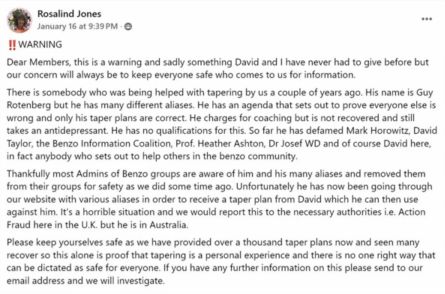
I do not deny using aliases for those test enquiries. I have explained that openly. Nor do I pretend that I held my current peer-work qualification at the time: in the recording I acknowledged that I had not yet obtained it. But disagreement with my approach does not make every criticism I raise false. And being on an antidepressant did not, in my view, give someone else the right to declare that I had not recovered from benzodiazepine withdrawal.
What particularly bothered me was a later reply in the same discussion: Rosalind said she had avoided the videos and refused to watch them, while explaining that David had watched and others had reported back. That distinction matters. I am not claiming nobody on their side had seen my work. I am asking why such a personal warning came from someone who said she would not examine it herself.
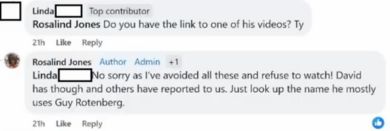
I experienced this as an attack on my credibility rather than an answer to the substance, and I considered it defamatory. That is my assessment, not a court finding. My point is not that everyone who received help from them had my experience. It is that receiving help should not require surrendering your right to question it.
Gratitude is not a lifetime agreement to stay quiet.
The “Terry” test, November 2024
By late 2024 people kept telling me David's plans had not changed. So I tested it. I wrote to Beating Benzos under a different name, as a 66-year-old man on 20mg of diazepam, and asked for a water taper plan. Yes, I used a fake name. I doubt he would have answered me under my own. The reply came from the Beating Benzos account, signed David: “Not a doctor nor pharmacist, retired high school science teacher living in England.” and “The pill reduction is done by using a metal nail file.”
The plan attached to it went 20mg to 18, 16, 14, 13, 12, 11, 10, and then: “Continue down by 1mg decreases until off.” One milligram at a time, all the way down. That is a linear taper again, the same thing I was given in 2023. Beating Benzos' own guide explains why that gets harder and harder as you go down: when you cut the same amount every time, each cut is a bigger percentage of what is left. And when I said so publicly, this was his answer:
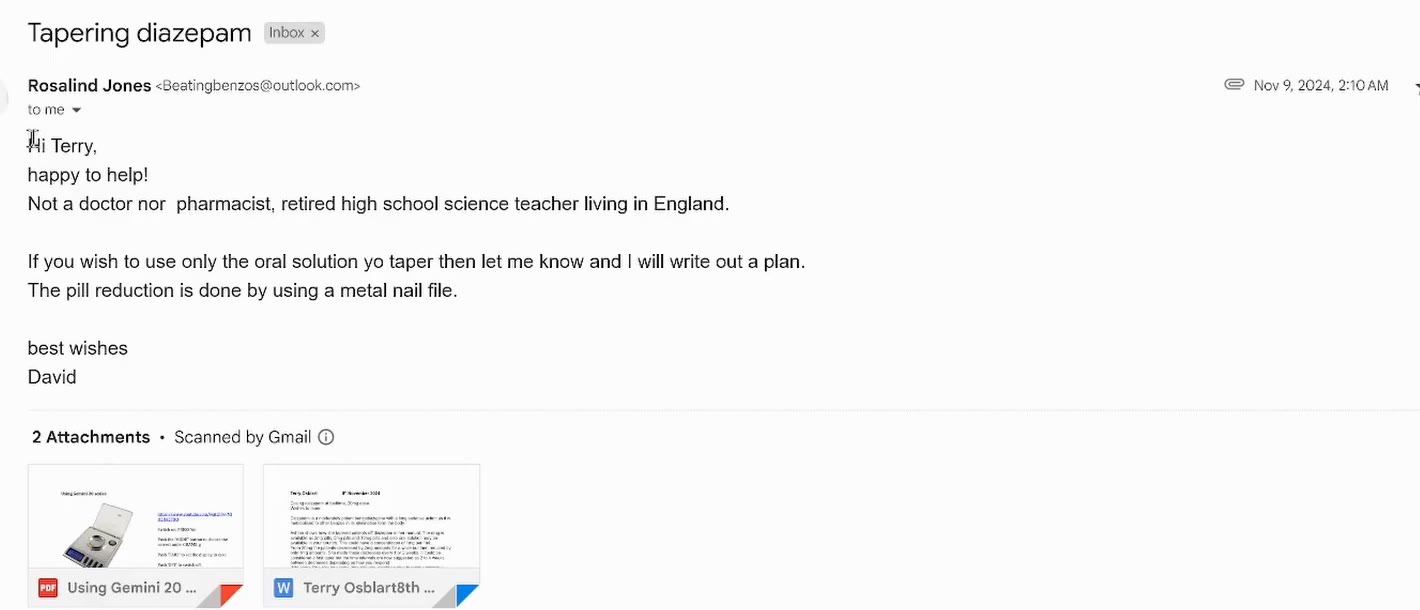
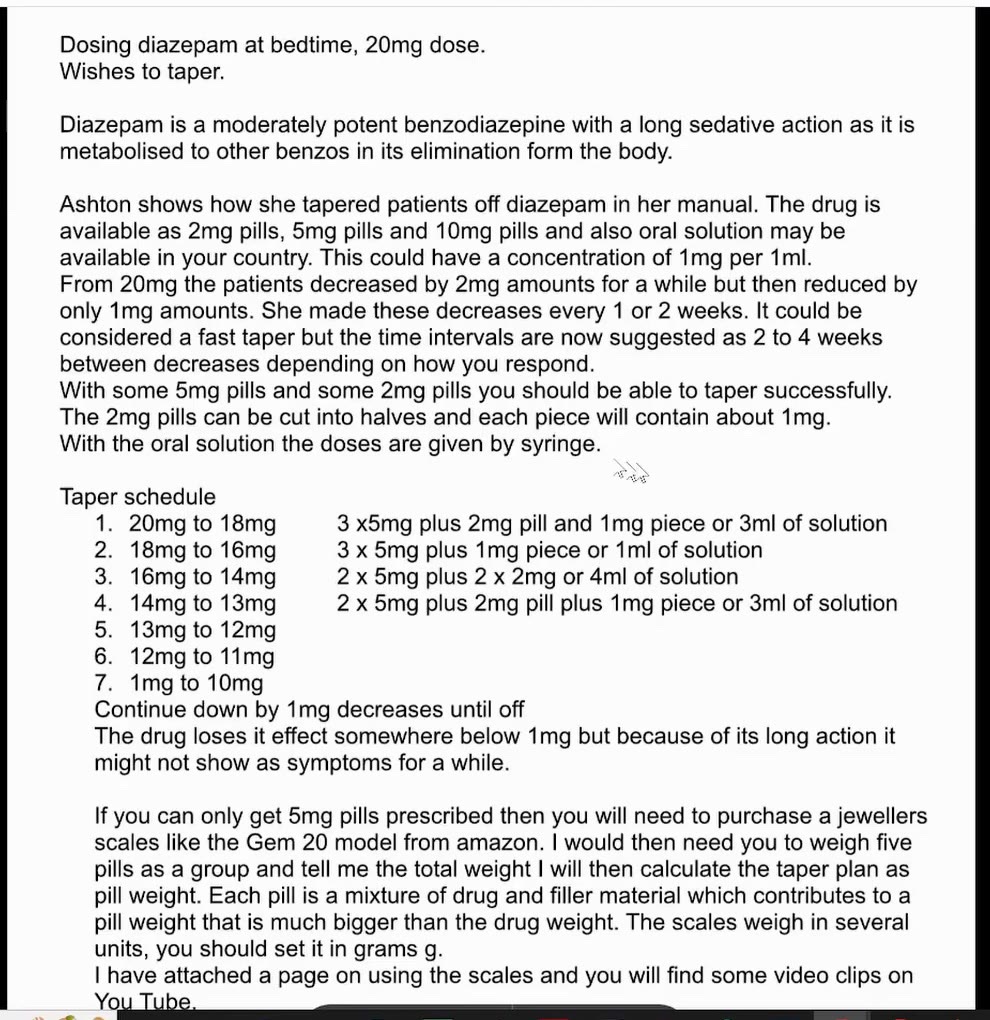
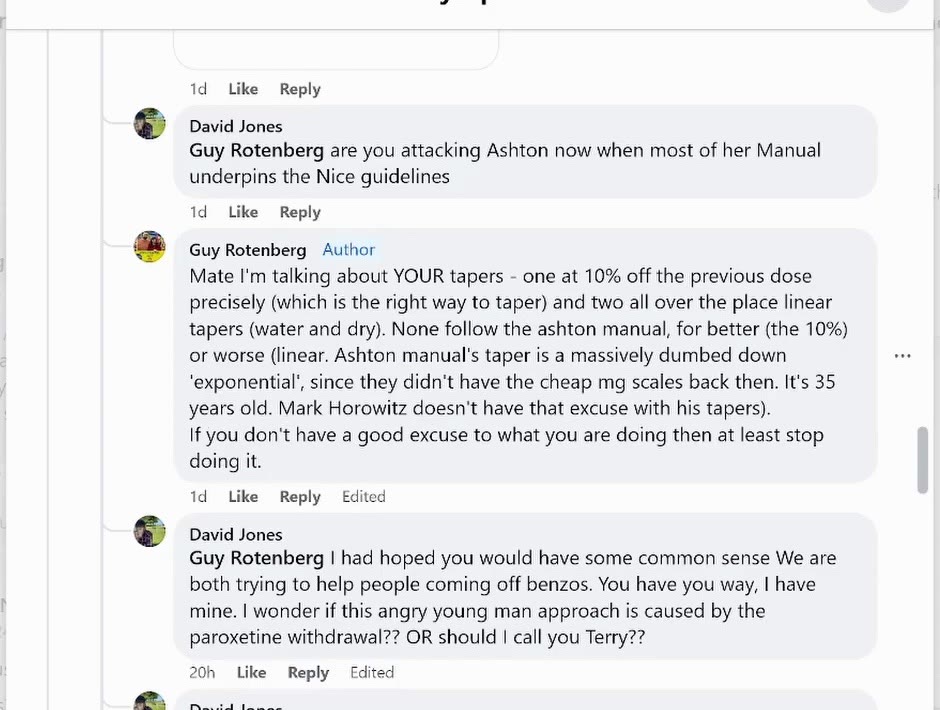
My medication was fair game. My argument was never answered.
And because I do not want this to rest only on selected quotes, I have covered the full picture on my YouTube channel — including the defamatory post and serious problems I found with David's taper plans:
My emails with Baylissa and the Peter Smith connection
My concerns did not begin with a public post or a YouTube video. I contacted Baylissa directly while I was trying to decide whom to trust during withdrawal. Part 5 of my story recounts those emails and my experience with Peter Smith. Below are her actual words.
What prompted my question was the Amazon description of Baylissa's book, Recovery and Renewal. It included an endorsement from Peter Smith alongside endorsements from Heather Ashton and David Healy. Peter was advocating a substantial supplement protocol, while Baylissa's warnings had left me deeply wary of supplements. Seeing his name promoting her book added to my confusion, so I emailed her to ask whether she knew him. As I recount in my story, she said she did not.
See Peter Smith's endorsement on the book page
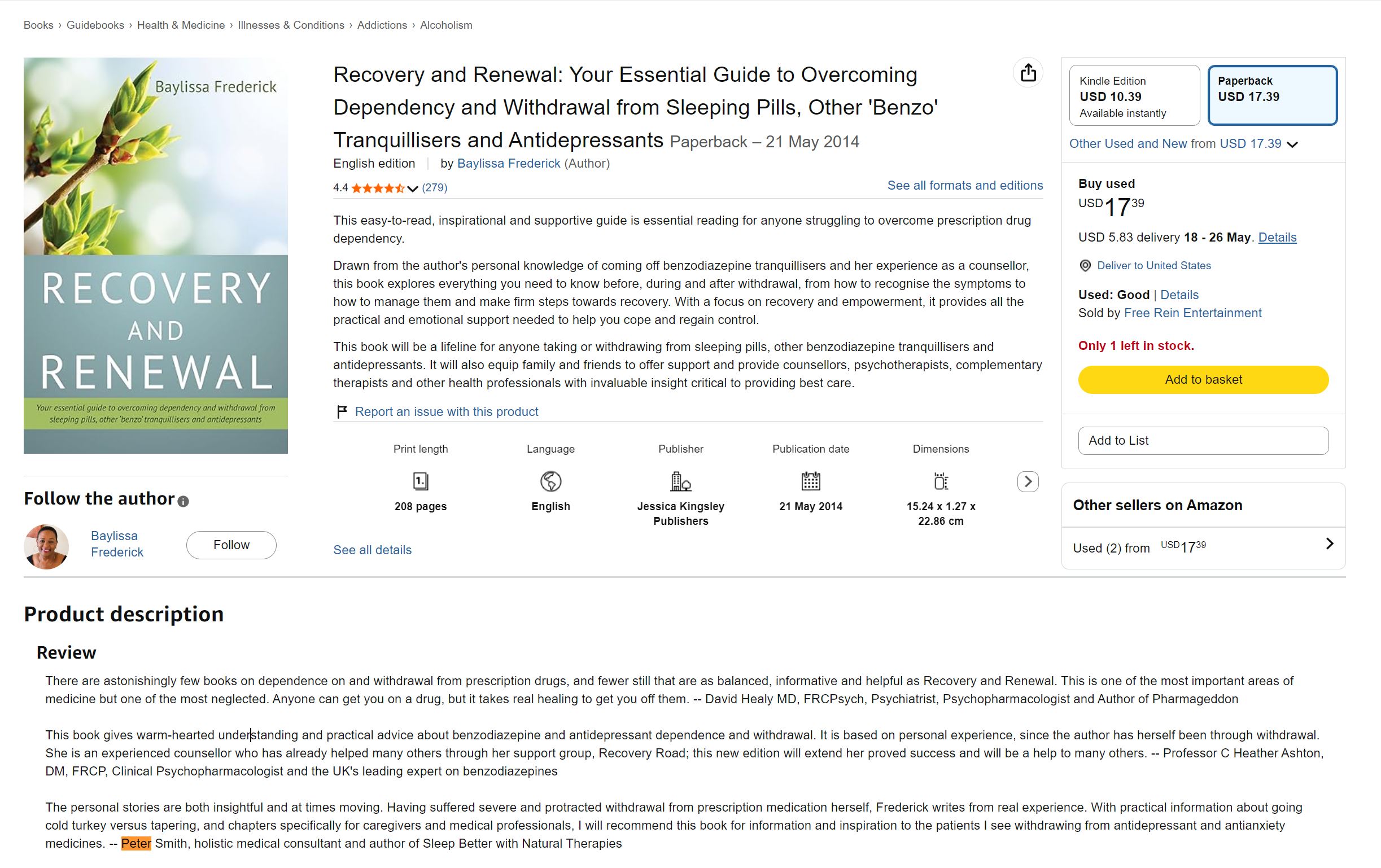
At the time, I found her answer hard to reconcile with the book page. But an endorsement of her book is not the same thing as her endorsing his work, and a publisher can obtain or use an endorsement without a personal relationship between the people involved. I cannot infer from that page alone that her answer was dishonest. What I can describe is the uncertainty it left me with as someone looking for help.
The warning that later became uncomfortably familiar
She wrote back that she didn’t know him. Then, in the same email, she listed the adverse reactions her clients reported most often, and right there next to ashwagandha: coffee enemas. I laughed. I wrote back “Coffee enema?? Don’t worry I won’t do that!” Then, in one of my last appointments with Peter, he suggested exactly that. It doesn’t prove she knew him. It does explain why I have never forgotten it.
My emails with Baylissa, August 2023
I describe my experience with Peter himself, including what genuinely helped, in his own account.
What I needed was help making sense of conflicting advice while I was frightened and unwell. Instead, I often felt caught between a protocol I struggled to get clear answers about and warnings that made almost every alternative feel dangerous. That is why these emails and the Peter Smith story matter to me: they are part of the experience behind my insistence on clear explanations, individual care and support people can actually reach.
Baylissa and Rosalind: when caution starts to feel like fear
In a post dated 28 June 2017, Rosalind reposted a long message attributed to Baylissa Frederick. The screenshots I retained show warnings covering an enormous range of supplements, medicines and other approaches. They also show important qualifications: people respond differently, some report benefits, other illnesses and deficiencies may need treatment, and nobody should pressure another person to take something or promise a cure. I agree with those principles.
What troubles me is the surrounding message. Linking such a broad range of options to accounts of severe crises, alongside statements such as “Band-aids won't work,” can leave a frightened reader feeling that almost any attempt to find relief is a mistake. That is how this kind of messaging affected me. My objection is not to reporting adverse experiences. It is to the leap from those reports to an atmosphere in which asking what might help feels reckless.
I want the risks examined, the possible benefits examined, and the uncertainty explained. I do not want reassurance used to close the conversation, and I do not want fear used to close it either. Something helping me does not establish that it will help you; someone else reporting harm does not settle what caused it or what will happen to every other person.
This is not an argument for taking everything. It is an argument for curiosity, proper investigation and individual care. People in withdrawal deserve more than a choice between a miracle seller and a warning against practically everything.
Read the 2017 post in its original context
Rosalind's repost of Baylissa's message, supplied as two overlapping screenshots. These include both the warnings I criticise and the qualifications I acknowledge above.
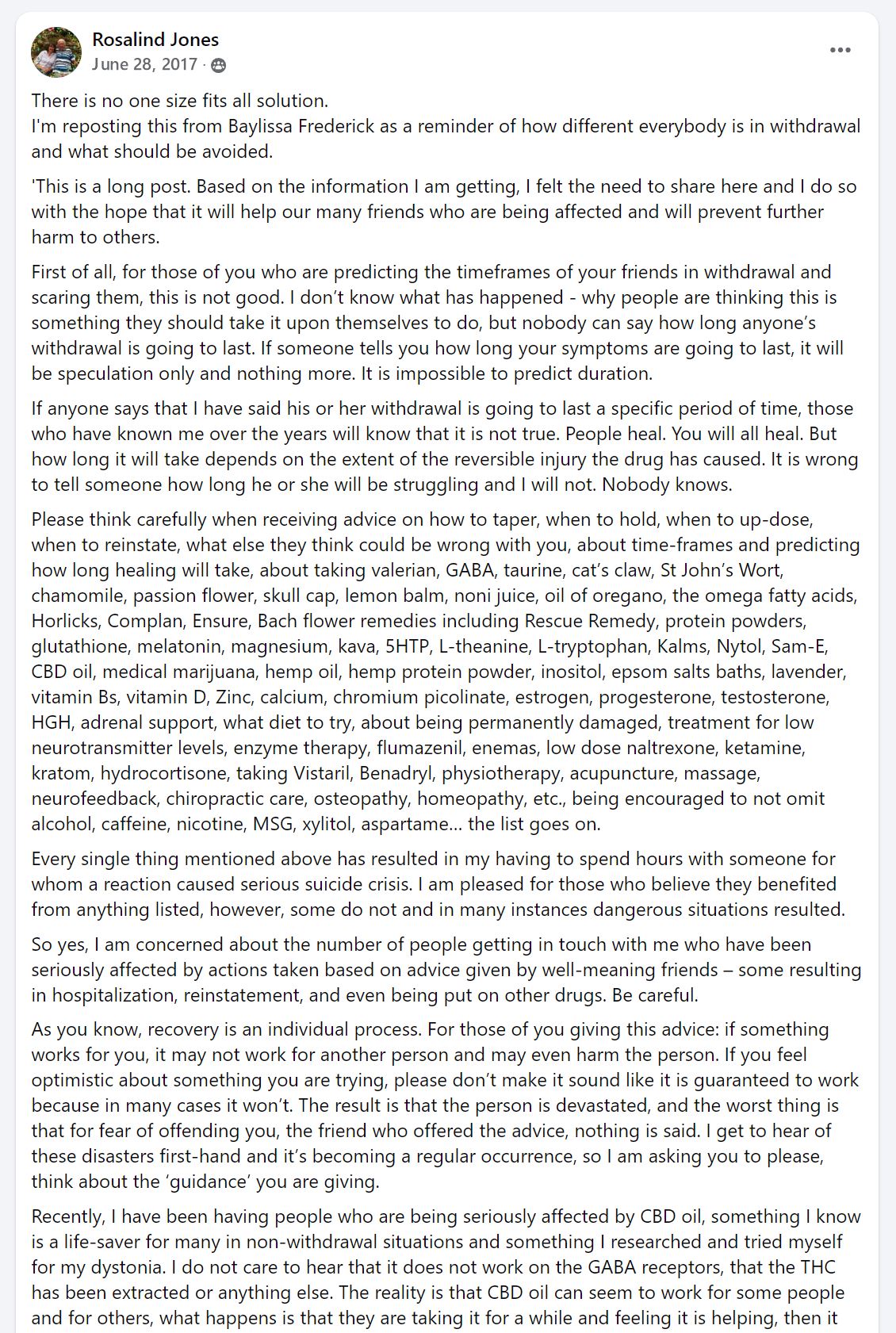
The later video and a conversation that closed
Baylissa returned to these themes in “When Vulnerable People Are Given Unsafe Messages”. I found its overall emphasis frustrating: to me, it risked reinforcing the same discouragement around looking for relief. But it would be inaccurate to summarise her literal position as “nothing helps”. At around 17:52, she acknowledges that some approaches may help a little or quite a bit, while others may do nothing or worsen symptoms. She also warns against treating either GABAergic or non-GABAergic labels as universal answers.
My account of what happened next is that I posted a critical response and later found it was no longer visible. Comments were subsequently disabled on the video. The comments-off notice does not establish what happened to my individual comment or why. Baylissa's written explanation says she does not have time to deal with comments and clarifies that she is not telling people to ignore facts or stop being proactive. I include that explanation below.
That still leaves my objection: a public message can continue influencing people after the public opportunity to challenge it has closed. I wanted a discussion of the concerns, not the last word. So I am setting out my response here.
See the video clarification and comments status


Josef Witt-Doerring and TaperClinic
I watched Josef's videos while I was in withdrawal, and they scared the hell out of me. Interview after interview with the worst stories in this world, including suicide inside a family, and no proper warning before it started. When your audience is people in withdrawal, that is not awareness. That is petrol on a fire. A clear content warning before every interview is the bare minimum.
People kept telling me he charges a fortune, so I checked, like any patient would. In October 2024 I emailed TaperClinic. The answer came from a “Patient Concierge”: fees “typically range from 30K to 40K for a year of care”, and the precise price only after a free “Discovery Call” with Dr. Josef.
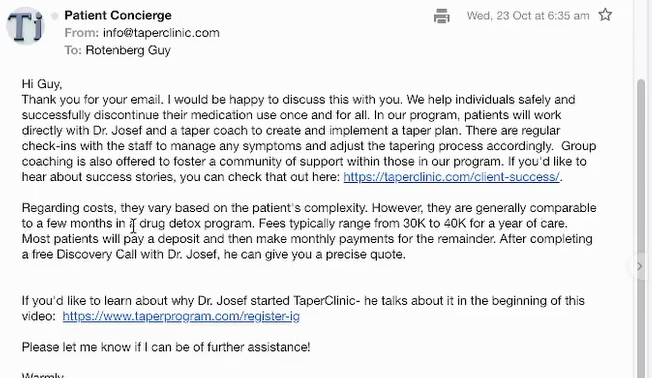
To get to the booking button you had to sit through his webinar. You could not skip it and you could not rewind it. I recorded myself watching it and reviewed it on 1 December 2024. It promised a protocol that gets you off your medication “that's going to be without severe withdrawal symptoms like brain zaps insomnia severe anxiety”, and that it works “this is going to work even if you take multiple psychiatric meds or if you've been on your medications for decades”. Nobody can promise that. It pushed: “time is of the essence i'm not running a busy call center here and these spots fill up quickly”. The booking calendar I opened straight afterwards was full of empty slots. And only after almost two hours came the fine print: “i can't help everyone”, and “if you're wanting to taper and you don't have any supportive family or friends who could help you through this this is not going to be an appropriate program for you”. Those are exactly the people who need help the most. That disclaimer belongs at the start, before the promises, not at the end.
The webinar quotations are transcribed from my screen recording of it; the wording is his, the punctuation is mine.
The “patients”
Then came the success stories: five patients, each with a name, an age, a job, a medication history and a photo. Amelia, James, Samantha, David and Cliff. Before withdrawal I worked in stock photography, and these looked like stock photos to me. So I checked, and I showed the results on camera. They are. Four of the five faces are sold in stock-photo libraries, and the fifth belongs to a customer review on someone else’s website.
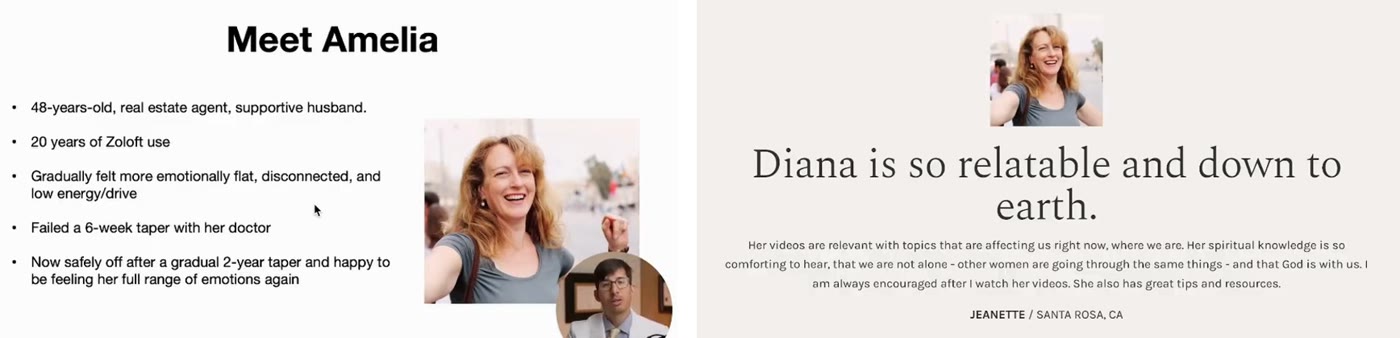
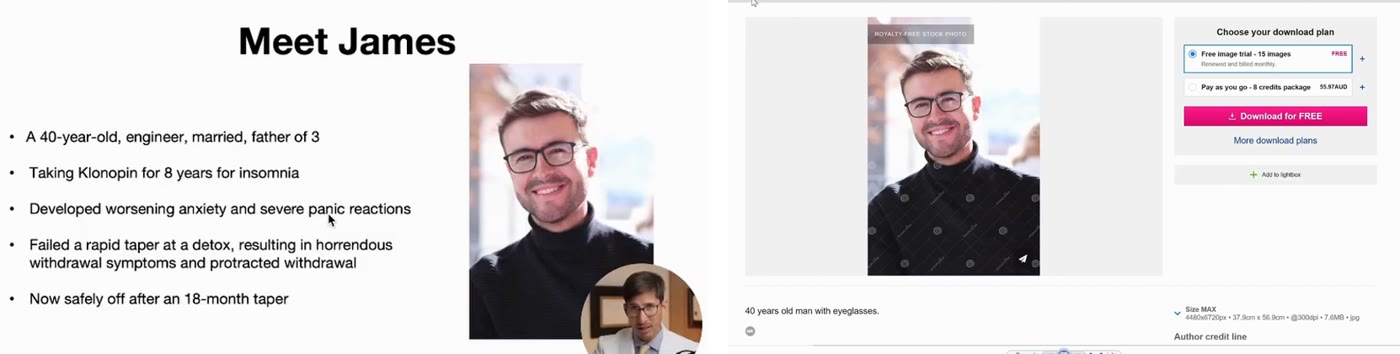

There was no asterisk. No “photos are for illustration”. Real-sounding names, ages, jobs and medical stories on top of stock photos. Maybe the stories are real and the faces were swapped for privacy. I do not know. Then say so. The way it was presented, someone as desperate as I was would believe these were his patients. In my opinion that is deceptive marketing, in a field where trust is everything.
The website has since changed, so all of this is about the version I recorded. To be fair, its current “Client Success” page is different: its 15 video stories look like real clients talking on webcam, cut with generic stock footage, and when I ran their thumbnails through a reverse image search on 20 September 2026, none of the people turned up on stock-photo sites. As checked on 12 September 2026, TaperClinic's admissions page lists its year-long programme at US$32,000 upfront or US$36,000 through its payment plan.
And then I looked at his connections. Josef sits on BIC's Medical Advisory Board. BIC's Medical Director is on his clinic's team page as its “Tapering Consultant”. BIC's own provider list lists his clinic ten times. The details, with screenshots and dates, are in the BIC section.
Mark Horowitz and the Maudsley guidelines
Of everyone in this story, Mark is the one I expected the most from. He co-wrote the Maudsley Deprescribing Guidelines. He has lived experience. People quote him to their own doctors. In June 2023, barely sleeping, I wrote to him with one question: how do you get through the very end of a taper, when the cuts become impossibly small?
Credit where it is due: he answered the next day, which is more than most. But his answer to a sick, unemployed stranger was an offer of paid “academic consultancy”: $250 for 50 minutes. I told him I could not afford it, that I was building a free tool for everyone, and that all I needed was one answer.
When I sent him my free spreadsheet, he told me my regimens were “not hyperbolic they are exponential”, and that to do it properly you would need nuclear imaging of the brain. In the same email he admitted the percentage method is “an infinite regress that never ends” and that the rules of thumb “do not make sense at the end of a taper”. The end of the taper was the only thing I asked about.
Here is what makes it worse. In his interview with Benzo Warriors, the one that sent me to him, he described the UK NICE advice of cutting 5–10% of the most recent dose as a pattern that approximates the hyperbola, and I played that part in my Updates video. In October 2023 he sent me a chapter of his own book. In it, as I show in the same video, the 10%-of-the-last-dose method used by withdrawal groups is described as a close approximation of his hyperbolic schedules and among the most helpful approaches. So in public and in his own book, the method I used was a close approximation of his. In private, to me, it was “not hyperbolic”, and fixing its end would take nuclear imaging of the brain. To be fair to him, in a later email he also wrote that exponential tapering “works so well” for most of a taper. The end was the part I was asking about.
Then the line I have read a hundred times. I asked when the book would be out. He suggested that if I got “some of the better off people” to buy a copy, his publisher “might be more well bestowed” to me. I had told him I was too sick to work. When I called that cruel, he wrote back that he was “not concerned with my profits” and wanted the book on doctors' desks. I believe the cause is good. But I did not need a marketing plan. I needed one number.
In November 2023 I asked twice more. Four days later: “I am not sure what you are after”. In the same email he warned me off the CBD that, in the end, helped get me off the drug. Later, at a public webinar, he said he could not say he was very familiar with those products. His book still files CBD as particularly unwise during withdrawal. I asked him why CBD was “not a good deal”. He never answered.
In December 2024, off the drug and doing well, I told him I had found errors in his book and asked whether I could discuss our old emails in my review. “Would be happy to know about any errors,” he wrote. When I asked about the emails: “I would prefer a private conversation not to be aired publicly, thanks.” I do not accept that a practitioner's answers to professional questions about his own published guidance are private, and I told him so. I sent him my review. He never replied to it.
And the tables. When the guidelines finally came out, the tail of the taper was built around the tablet and liquid sizes that happen to exist, not the precision the end of a taper needs. In my view, convenient tablet fractions win over consistent reductions. My full review of the Maudsley guidelines shows it step by step. Your suffering is not an acceptable rounding error.
The circle
Mark is not just an academic. By his own declaration in a 2026 journal paper, he “is a co-founder and consultant to Outro Health”, which, in the paper’s words, “helps patients to safely stop no longer needed antidepressants”, and he receives royalties from the Maudsley guidelines. BIC told me they “were even consulted on the benzodiazepine section” of that book and “fully support” it. BIC's provider list includes him (“Academic Consultancy Only. Not registered as a medical doctor in the United States”). And in June 2026 he published a benzodiazepine paper together with BIC's Medical Director, BIC's co-founder and Josef Witt-Doerring. The details, with screenshots of both papers, are in the BIC section. Same small circle, every time.
The whole correspondence, June 2023 – December 2024 (27 emails)
About these emails. My emails are shown in full. Mark’s replies are quoted only in part, because of copyright — enough to show what he said — with “…” where text has been cut.
I have seen your interview with BWC and was recommended to contact you but I have sent the information through your website's feedback form and not sure it got through (it sort of 'resetted itself' and I did get a message but I didn't get any email confirmation). Please let me know if your received it.
Cheers
Guy Rotenberg
Yes that might be good for me. Please send me details.
Cheers
Guy
… this is mostly aimed at Americans, you can pay AUD250 through here … [PayPal link] …
I have created a spreadsheet that anyone can use to easily put in his benzo/ssri and gives him a schedule. I have already published it for comments by admins and forum managers in different benzo forums/groups.
The only question I have and that's remaining to be answered by admins on most benzo groups including the one that interviewed your is how to deal with the long 'tail' at the end. With my example (attached), you can see that the first year is 76%, then the second is up to 94%, then the third year (!) is just for 4% until the jump dose which is 0.025mg as far as I know for K. This is not just for me, but potentially helpful for a lot of people. I am in fact including that interview you gave to Benzo warriors and other references by ashton herself and other sources of information as to why I created a hyperbolic taper. Unfortunately David from Beating Benzo, or rather his ego, and unlike the rest of the groups and benzobuddies admins who were thrilled by this, was not impressed with me contesting some of his linear tapers he gave to people, or talking about tapering in his group, and kicked me out and banned me when I dared to ask people to let me know how much their pills weigh to create a comprehensive template library for different brands and benzos etc for this spreadsheet. I am doing all of this for free.. and I don't have the means to pay $250AUD at the moment as you can imagine I don't work due to my condition. All I need is help with that last step, it's literally one question with one answer. I assume it would be to change the daily/biweekly/4 weeks cut to be higher toward the end, but I wonder if you have from your research some idea of how much is good.
Hyperbolic Benzo/SSRI taper plan (daily microtaper, 14/28 days 5% cut and hold, 14/28 days 10% cut and hold, dry or liquid taper) Version 1
Cheers
Guy
I had to google the difference I admit I don't remember much from uni math anymore :) There is a 'jump dose' to each benzo so it does have a 'stop point' and won't go to inifinity. But it just means that it takes 1 year to get to that jump dose from around 93% of the original dose. Would a safe 'quick fix' would be to just accelerate the reduction % as time goes on? what would you think a good acceleration regiment would be?
Hyperbolic tapering Benzos/SSRI safely using my taper spreadsheet on goo...
I wonder if you know when those guidelines will come around? let me know if there are any news. Would like to update my spreadsheet. A lot of people use it.
Cheers
Guy
You don't own the 'rights' to hyperbolic tapering - I made the spreadsheet months before I saw your video, for my own use, and then made if public after I realised they give people in 'beating benzos' facebook group also 'linear' tapers (the water microtaper) and people 'get worse' at the end which was like 'duh!' but david said it was because of people finding it hard to calculate daily. So I shared it. It was common knowledge in 'Beating Benzo' group to always taper a % off the previous dose in 'cut and hold' and that's the way I am supposed to do that also according to my functional medicine practitioner. It's also partially how Ashton's taper is, just more crude. I included your video in my video because your interview (which is free on youtube) explains it well, not because it's new knowledge on how to taper. You just proved why it works better. The only thing I don't understand is how I can taper 5% a month without it taking 6 years to get to the jump dose - that's the only question I have - please don't be cruel and just share. I am sure it won't take away from your profits.
… Exponential tapering and hyperbolic tapering are very similar for large portions of tapering trajectories … exponential tapering never ends …
… The dose regimens I outline will not fit onto your spreadsheet if they are built around exponential reductions - as mine are based on receptor occupancy. …
Please forgive me if I was blunt or angry in my last email.. i am just feeling 'trapped' and scared. Not to mention my family is from israel, and while living here, my situation is making my mother sick herself and with everything that happens in israel it affects us too. I am actually relieved I stopped the taper, even though I felt I am wasting time.
This is why it is so chaotic for me.. - I am tapering Klonopin. I am now at 1.01mg, started 5-6 months ago from 2mg with a lot of starts and stops. I take it once a day at around 8:15pm. I know it's usually better to take twice a day but I don't know how to divide the dose without falling into another 'wave'. I am also afraid to 'move' to diazepam as I'll be completely at the mercy of my doctor, and right now I have a lot of Klonopin 2mg pills saved (I use the 0.5 ones though to be more accurate with the microscale) in case he can't prescribe me, although it's tiny pills and makes it hard to taper. I also don't know if my body will 'like' diazepam. I am scared of any changes to be honest.
I only took it for 28 days, when starting Paxil and having really bad side effects from it (crying, drowsy, major depression) by a doctor who fell asleep 4 times in front of my eyes (after they wouldn't let me see a psychaitrist in the GCU hospital after waiting 5 hours) who said 'worst case we'll taper you' when I asked him what will happen if I take it more than a week or two. Then was told that I can go from 2-2.5mg I was taking twice a day to 1mg once a day by a psychaitrist. I started having literral 'waking' night terrors/nightmares - waking up to paranoid abstract waking nightmares after an hour of sleep, then having 'closed eyes hallucinations' when trying to go back to sleep and hypnic jerks, or delusions about my body etc everytime I closed my eyes. After 6 days I went to RBWH and only after waiting again for long hours and being told again I 'don't have a problem' they told me to go back to 2mg and stabilise on both that and paxil. I had 3 weeks of agrophobia crying and anxiety and slowly started to get better. after 5 weeks of feeling good, I started tapering at %1 exponential a day. I was ok until anxiety from remortgaging my house drama got the better of me and the insomnia was back and a few days later - the horrible waking dreams. I then stopped and stabilized again, this time taking agmatine and it helped me a lot with pins and needles and I started to sleep again although only 4-5 hours. Then started taking more supplements that helped (glycine, magnesium glycinate, taurine and theanine). It's very scary to take anything as all the groups always say 'no supplements they can cause issues' and on the other hand they do seem to help.
Then tapered at 0.4% a day (around 10% a month) and after 8 weeks I had a cold for a week, drank a lot of cucumber juice and celery and I think I 'detoxed' myself which caused another setback with the same symptoms. This time I started working with Peter Smith from London who prescribed me lots of other supplements... I continued to taper at 0.3% and had a setback again (2 weeks after starting, although the supplements really helped, I still take them). I stopped for a week of Insomnia (the paranoid nightmares only happened 1-2 days thank god) and then got my sleep back, but now 7 weeks into this hold with still daytime anxiety, although have good reasons to be anxious given the financial and psychological and life altering concequences, the doctors who won't prescribe or don't even understand how to taper (including AODS and rehabs in the Gold Coast) and the 'big brother' of Australia who can tell my dr at any time he no longer is allowed to prescribe me. which is why I saved a lot of 2mg klonopin pills in case that happens. 3 weeks ago also started taking CBD (building up slowly). The last 4 days I think it actually helps me. I have an appointment with [the CBD doctor] (from [his clinic]) in a week's time who is a sleep specialist and use CBD/THC to wean people of benzos, hoping his knowledge will help me as well.
When the book comes out, I promise to buy a copy! if they'll sell it in Australia. And I'll buy one more for my GP and AODS. There is only one body here in Victoria that does somehow proper tapering called Reconnexion (10% every 2-3 weeks) and actually gives coaches to patients but that coach help is only in Victoria unfortunately.
Cheers
Guy
Can you please send me some info about the Klonopin?
Cheers
Guy
Sorry not trying to nag.. but please reply to me if you can help.
Cheers
Guy
[The CBD doctor] sounds like he is going to switch you from a benzo to CBD - not sure if that is such a good deal to take.
What I wanted was the 'end of the taper' bit - where it would go on for years if i keep the exponential tapering schedule happening (before the jump dose), but you said it would take a year if I go faster toward the end, and that you can send me the klonopin tapering schedule so I can do it the way you recommend.
I stopped the taper to try the cbd/thc and I sleep now without the lots and lots of supplements for sleep (except I take mag glycinate/taurine/glycine before bed) but the morning anxiety/cortisol rush is delayed but still really hard. I feel it in my chest and legs. not sure the CBD by itself helps but [the CBD doctor] says he weaned a lot of patients of his (he was prescribing benzos) and moved them to CBD/THC and that its really hard without a replacement drug and thats what the CBD/THC is. But he thinks of doing it quite rapidly (build in a month, then take HALF the klonopin for a month and updose the cbd/thc, then off completely and updose the CBD/THC again, then slowly reduce the replacement). I don't want to go that fast, so I'll try 10% cut first. Why do you think it's not a good deal?
I have now finished my taper. I am around 14 weeks after sessation and doing amazingly well.
I have purchased and read your book. I am planning on doing a video about this, and have a lot of things that I find really great but also a lot of things that I think raise questions, and also what I think are some errors and contradictions. My questions are:
1. I would be pleased to include some of our previous conversations here, as they are relevant, for example the CBD oil etc. I am sure you are open to debate about this.2. I would like to use for example pages from the book in the video - specifically a few taper plans where I think there are errors? I will be glad for you to answer those things in response of course once the video is out. I will not publish more than around 10 pages, which are relevant to the review, and I believe most of this is already available online in your many webinars and your online videos already.
Please let me know as soon as possible, so that I can publish the video.
Cheers
Guy
The publisher owns the rights to the book now not me - I know they don't like their copyright being violated but I am not sure if they would pursue you … perhaps not. …
I have asked them 'officially' through their channels but I can also use the benzo warriors interview as it covers similar things. Are you happy for me to discuss conversations we had here before?
Cheers
Guy
Awaiting your reply.
I personally don't see your response as a practitioner to my questions as private as these were professional questions and answers, but I took a path of caution anyway and since I have waited a week for this response I have already made the video but omitted the actual content and just described in general that I have known about your work and contacted you in the past when I was in severe withdrawal and that we chatted about these subjects (exponential vs hyperbolic) and that I never got a response from you in regard to why you commented to me that switching to CBD is a not a wise idea. This is public interest and related directly to the topics I bring up.
In any case I don't consider this or future correspondance with you as private. I have published my video, you are welcome to respond to it.
https://www.youtube.com/watch?v=dw8D5Y8emKU
Cheers
Guy
Maudsley Deprescribing Guidelines for Benzodiazepines, Antidepressants, ...
BIC: why that reply stayed with me
My exchange with the Benzodiazepine Information Coalition was not just an unanswered email. In December 2024 I sent them my video review of the Maudsley guidelines and asked them to take down the linear water-taper example on their website: a capsule in 300ml of water, take away 1ml a day. That is the exact method David gave me. Their answer: nobody would have time to watch my video; there is no evidence for supplements; “one individual’s opinion doesn’t change the thousands of emails of harm we receive”; they “fully support the Maudsley Deprescribing Guidelines”, and they “were even consulted on the benzodiazepine section”. So they were defending a book they had been consulted on. And the part nobody mentions: they agreed the example was unclear and removed the specific amount from their website. My criticism changed their page.
My emails with BIC, December 2024 – January 2025
I replied sharply myself, calling the response rude and saying I would make a video about it. I should not leave that out. The subsequent message said my expectations of their time and attention were disproportionate to my knowledge and experience, and ended the conversation.

I understand that a volunteer organisation has limits. I am not entitled to unlimited attention. What stung was the move from disagreeing with my arguments to measuring whether my knowledge and experience merited engagement. That felt uncomfortably familiar. An organisation can do valuable advocacy and still fall short in how it responds to a person challenging it.
See the closing portion of BIC's earlier reply
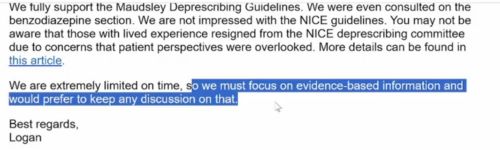
Who runs BIC, and who BIC sends you to
After BIC told me my “expectations of our time and attention are disproportionate to your knowledge and experience”, I looked at who runs it. When I wrote to them, I knew none of what follows. I found it afterwards, and honestly, I felt stupid. Everything below comes from public records, and I show each one with the date it was live.
The people
BIC is a US charity, a 501(c)(3), and its tax return is public. According to the latest one, filed on 13 December 2025, Nicole Lamberson is BIC’s “Medical Director and Officer”. BIC paid its officers nothing, Nicole included.
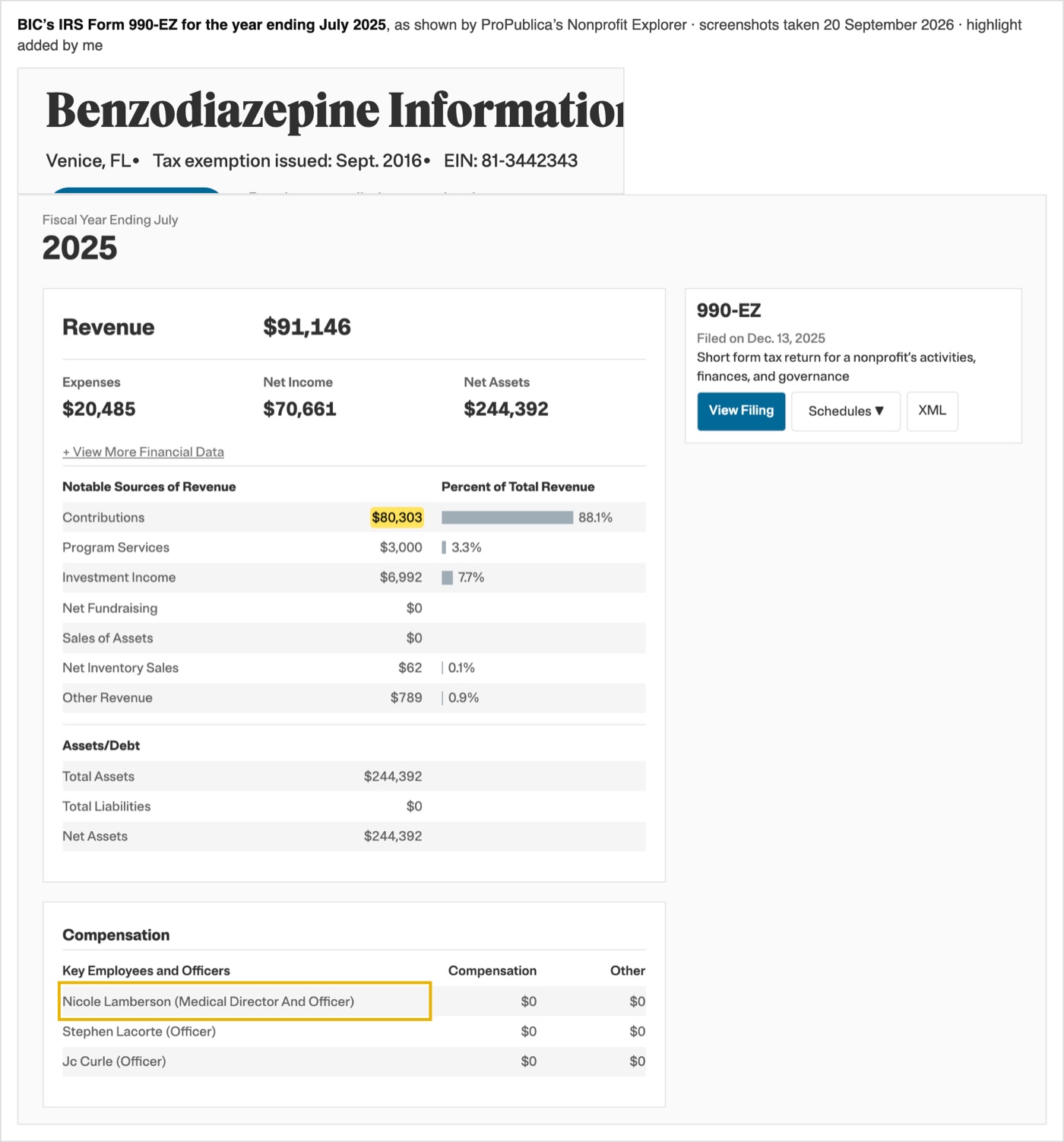
Now the timeline. On 31 December 2023, BIC’s website listed Nicole, Josef Witt-Doerring and Chris Paige on its Medical Advisory Board. On 24 February 2024, TaperClinic, Josef’s clinic, had a page for “Coach Nicole Lamberson”, and one for Chris Paige. By 20 April 2024, Nicole had become BIC’s Medical Director and joined its Board of Directors.
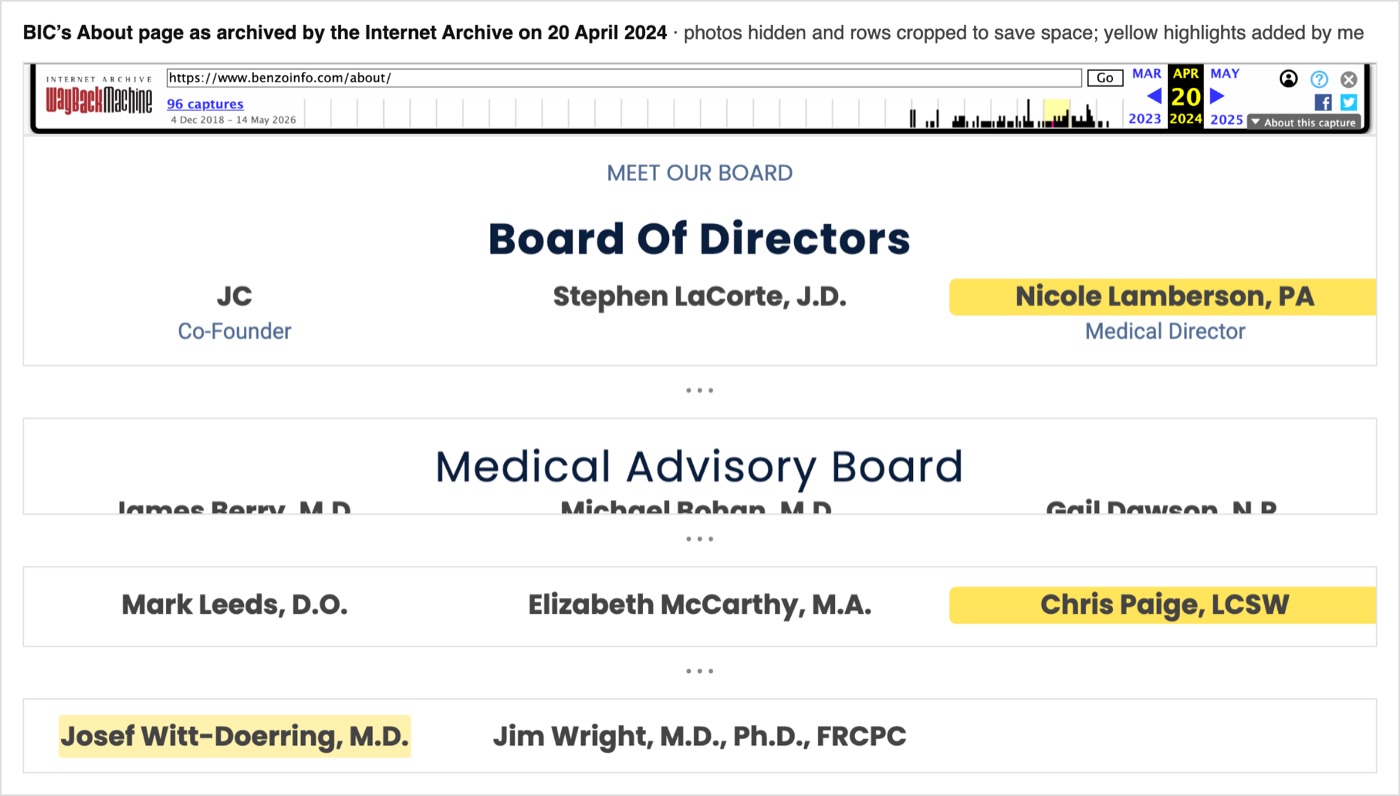
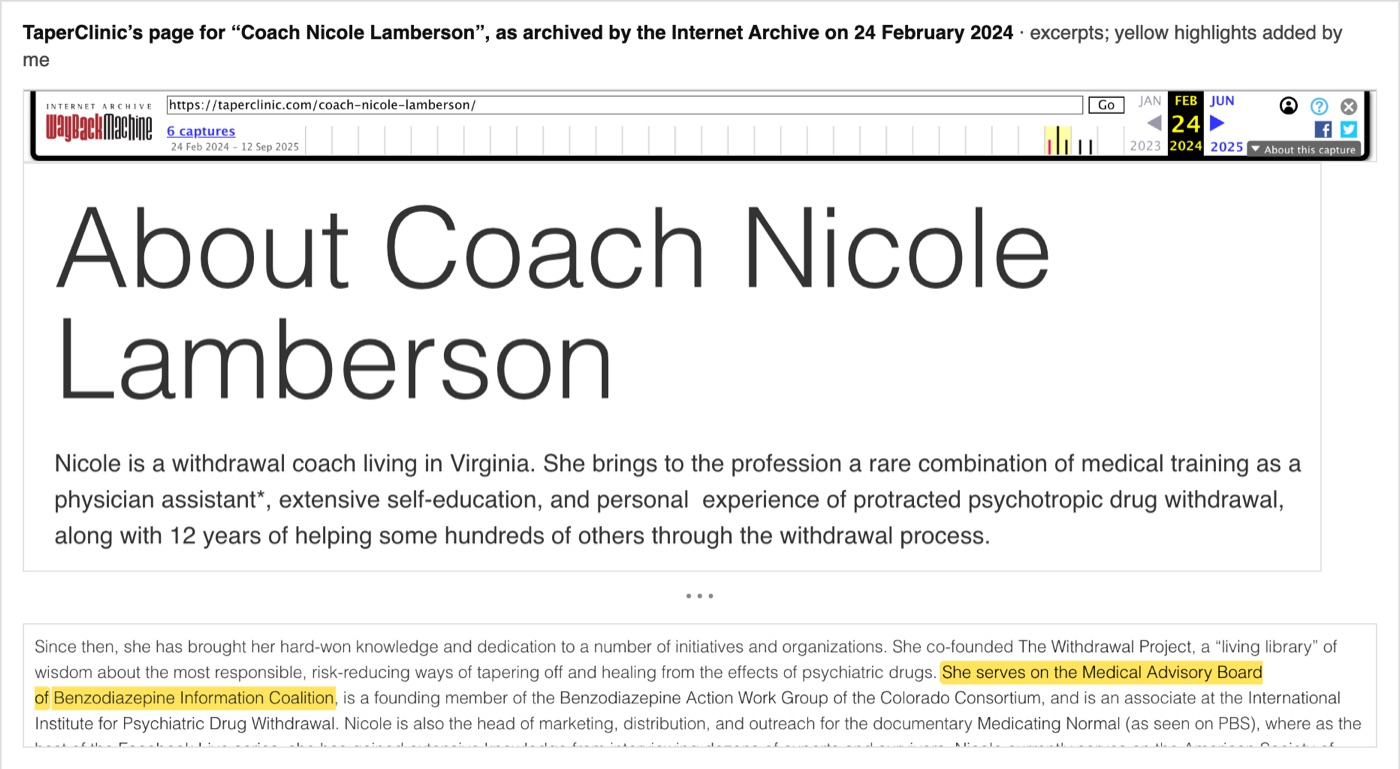
Nothing has changed since. On 20 September 2026, TaperClinic’s own team page lists Josef as its “CEO & Medical Director”, Nicole as its “Tapering Consultant” and Chris as its “Withdrawal Support Specialist”. This is the clinic that quoted me US$30,000–40,000 for a year of care.

She is not just a name on a staff page. TaperClinic’s “Client Success” page has a video called “When Healing Happens”, in which, the page says, “our team reflects on some of the most powerful and inspiring moments we’ve shared with clients”. Nicole is in it, captioned “Nicole Lamberson, Taper Consultant”. Right after telling the camera that she has seen “countless people go through withdrawal since 2010”, she says: “you just have to have faith and blindly trust that those of us who’ve walked this path ahead of you are telling the truth and that healing is inevitable.” I understand the kindness behind that. But in my opinion nobody in withdrawal should be asked to trust anyone blindly. Not her, not TaperClinic, and not me.
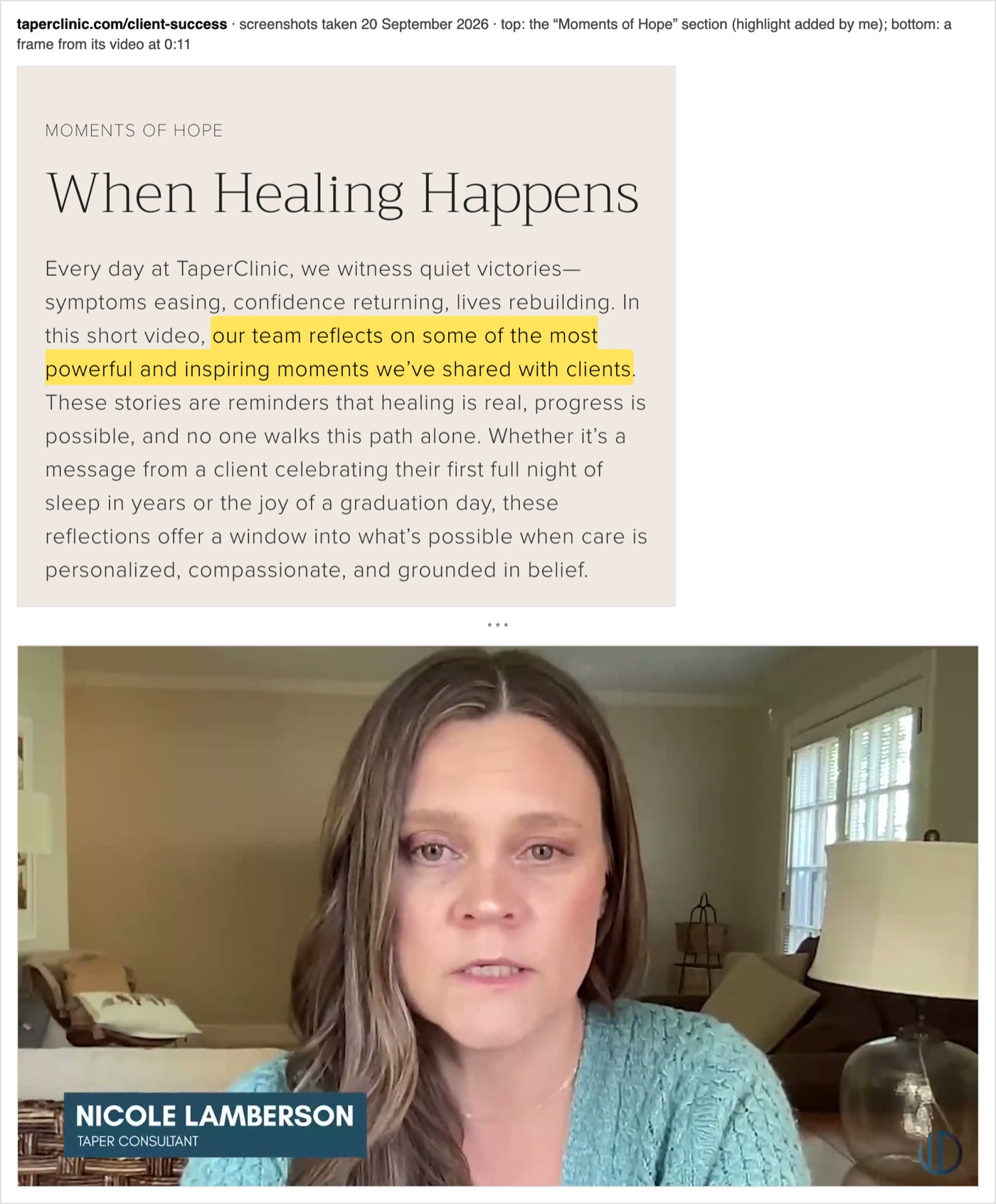
The list
BIC keeps a list of “cooperative providers” for people looking for help. On 20 September 2026, Josef’s clinic was on it ten times, under ten different states, each time with the note that he is a member of BIC’s Medical Advisory Board. Nicole was on it 51 times, for “Taper Coaching and Academic Consultancy”, with the note that she is BIC’s own Medical Director. Chris was on it too, as a member of BIC’s Medical Advisory Board. To be fair, the list does disclose those BIC roles. What it does not say, anywhere, is that Nicole and Chris are on the team of Josef’s clinic. And the same page says BIC “is not affiliated with nor does it sponsor these providers”.
Nicole’s entry also says she is “Not licensed as a physician assistant or other medical professional in the U.S. or elsewhere.” The title “Medical Director” is theirs, not mine.
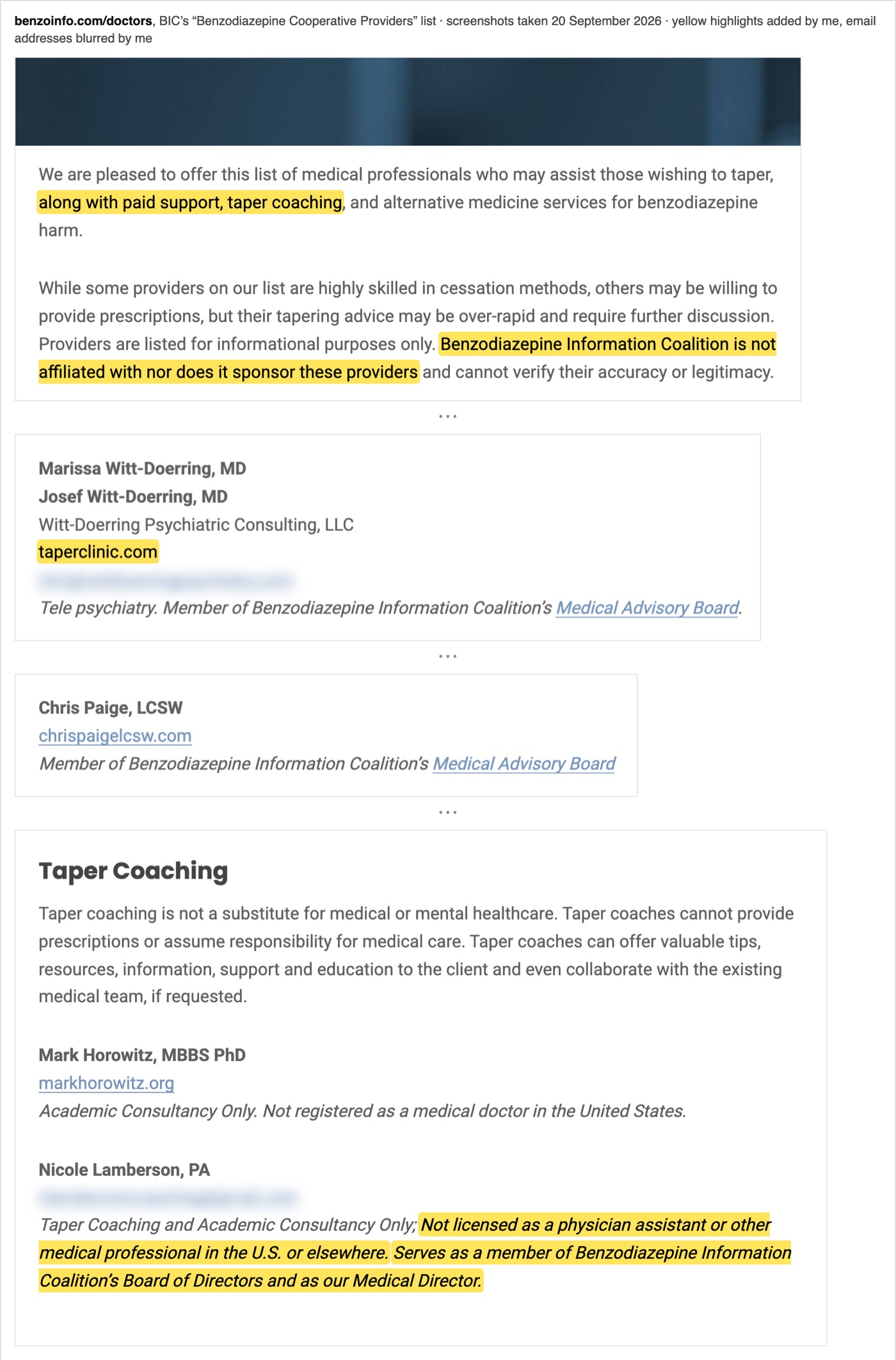
The papers
On 9 June 2026, Nicole, BIC’s co-founder Janice Curle and Josef published a paper on how to taper benzodiazepines, together with Mark Horowitz and others. All three give BIC as their affiliation, not TaperClinic. The conflict-of-interest statement lists Mark’s royalties and an editorial role, and ends: “All other authors declare no conflicts of interest.”
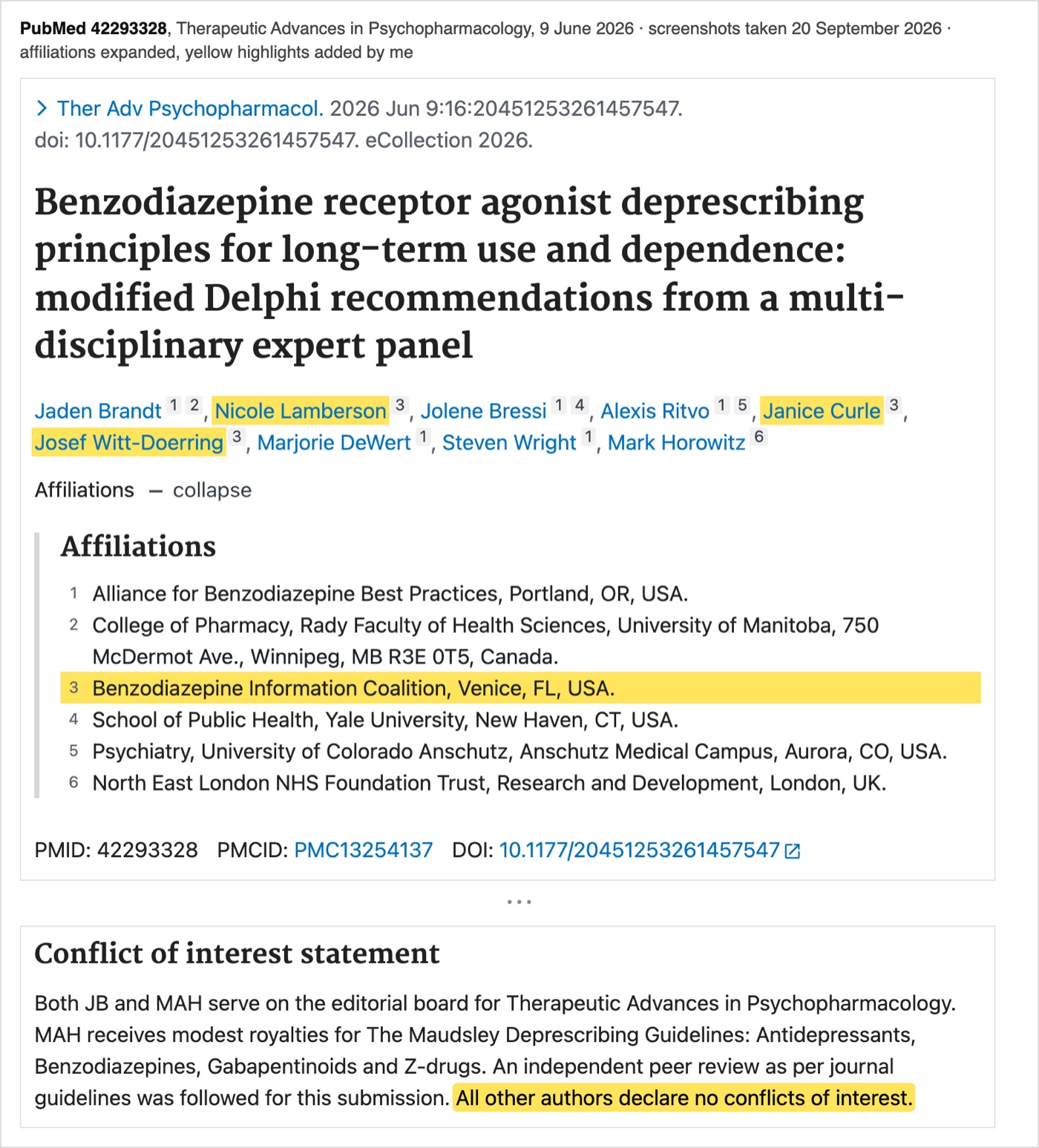
Nine days later, a second paper, by Mark, Nicole, Anders Sørensen and others, declared that Mark “is a co-founder and consultant to Outro Health”, a tapering service, that he receives royalties from the Maudsley guidelines, and that Anders receives royalties from his book Crossing Zero. Neither paper’s affiliations or conflict-of-interest statement mention TaperClinic.
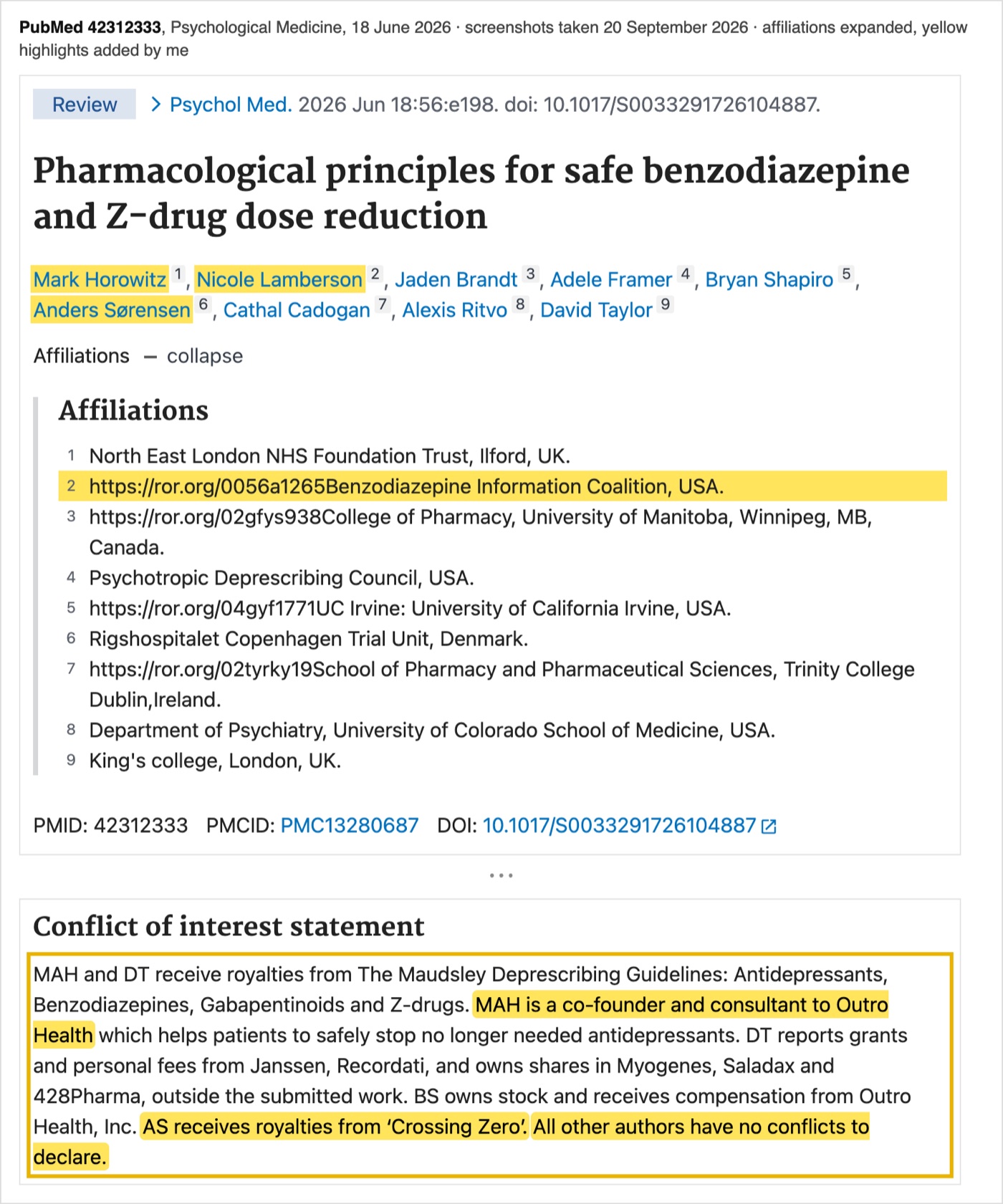
What I make of it
I am not a lawyer, and I am not accusing anyone of breaking the law. I found no record of money moving between BIC and TaperClinic, and BIC’s tax return shows it paid its officers nothing and made no loans to or from them. Volunteering for a charity while working for a clinic is not illegal, and journals leave it to the authors to decide what to declare.
But in my opinion, two authors of a paper on how to taper who are on the team of a clinic that charges tens of thousands of dollars a year for tapering should say so. And a charity whose Medical Director is on the team of a clinic it lists ten times should say that on the list, instead of telling readers it is “not affiliated” with the providers on it. People choosing who to trust with their taper deserve to know. To me it is the same small circle every time: the book BIC was “consulted on”, the clinics, the charity, the papers, and the people who told me they had no time to watch my video.
Why I think BIC was so hostile to me
Look at the dates. On 1 December 2024 I published my review of TaperClinic’s website on YouTube, stock-photo “patients” and all. Around 20 December I published my review of the Maudsley guidelines, and on 21 December I sent it to BIC. On 9 January 2025 BIC answered that it was “unlikely that anyone will have time to watch the full video”, that “one individual’s opinion doesn’t change the thousands of emails of harm we receive”, and that they “fully support” the guidelines and “were even consulted on the benzodiazepine section”. That same evening came the last one: “Do not contact us again.”
I cannot know whether anyone at BIC had seen my TaperClinic review, or what was said among them. But if they had, then within one month a stranger had criticised the clinic that their Medical Director is part of and that a member of their advisory board runs, and then the book they were consulted on. That would explain a lot about the tone I got. This is my theory, not something I can prove.
Trying to reach someone else
After the exchange with Logan, whose tone I found rude, I tried to contact other people listed on BIC's website. I wanted somebody else to hear the concerns and look at what had happened. I also tried to reach Stephen LaCorte, JD. I recall finding an email address for him, although I no longer remember how I obtained it. I did not receive a reply.
I contacted Chris Paige through Facebook. (Only later did I find out that Chris has been part of Josef’s clinic since at least February 2024.) My opening message was friendly, and he initially replied, “How can I help?” I then explained my disagreement with BIC and shared my criticism and the correspondence. My account is that he blocked me after that exchange. I was upset and challenged him through his professional page, asking whether they were a clique or genuinely wanted to advance recovery. I received no substantive reply there. The screenshots show the initial response, what I sent and my later complaint; they do not independently establish the reason for the loss of access. I include my own confrontational follow-up because leaving it out would give an incomplete picture.
Part of my frustration was how difficult I found it to identify a direct route to the people I wanted to speak with, rather than return to the same organisational inbox. That is not the same as saying none of them has public professional contact details: Chris's BIC profile, for example, links to his private-practice website. I am describing the difficulty I experienced getting a conversation, not claiming that people owe the public their personal email addresses or phone numbers.
Even co-founder Janice Curle's BIC biography has no profile photograph on the page I checked. That added to my sense of distance, but a missing photograph is not evidence of wrongdoing, and I do not know her reasons. What matters more to me is whether there is a workable way to raise a concern and have it heard.
People who cannot be reached worry me. Advocacy needs a door people can actually knock on.
Read my messages to Chris Paige and the professional-page follow-up
Seven supplied screenshots, presented without alteration. The personal-profile conversation is followed by the separate professional-page thread. These are records of what was said, including my own criticism, not medication instructions or proof of anyone's motives.
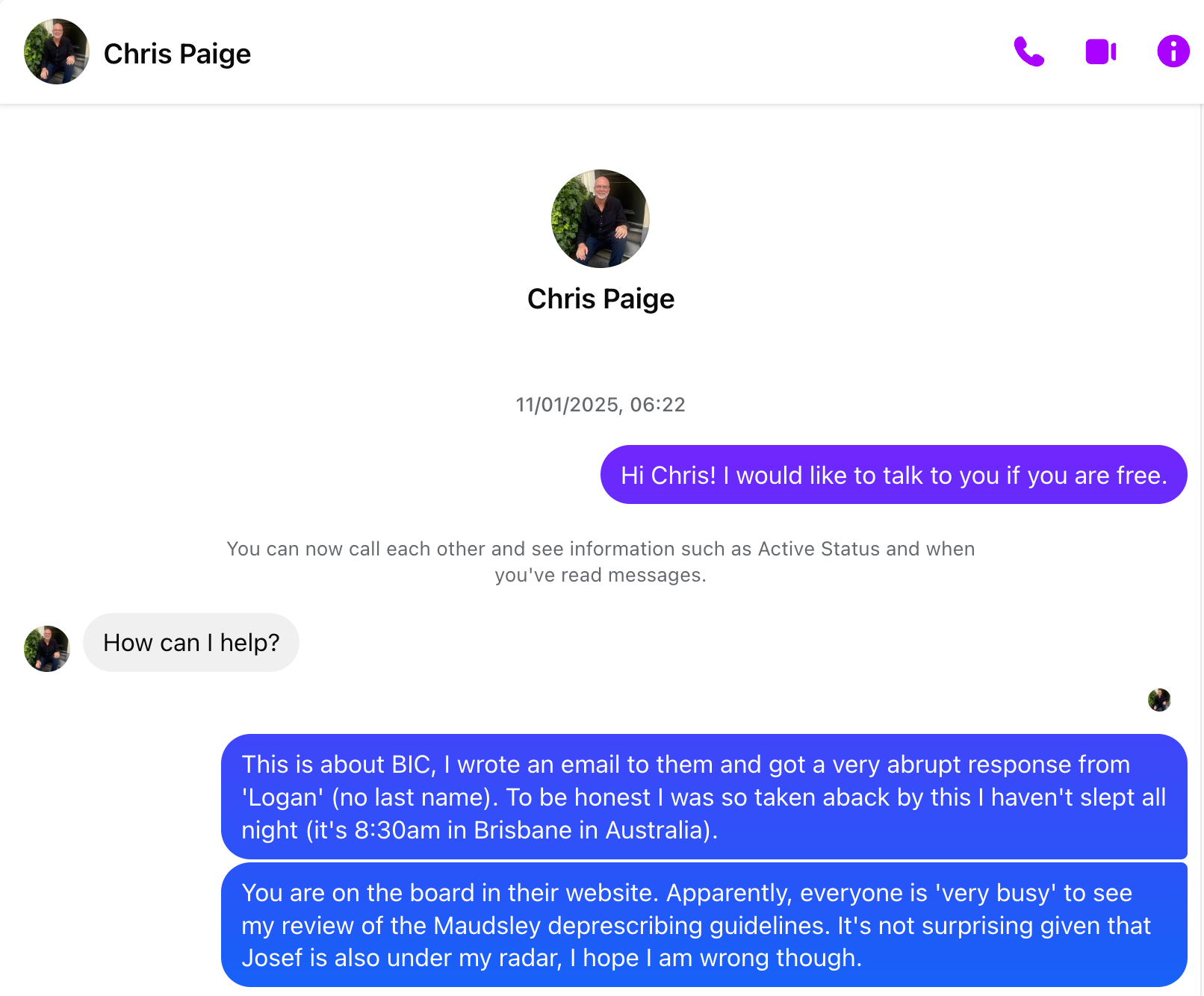
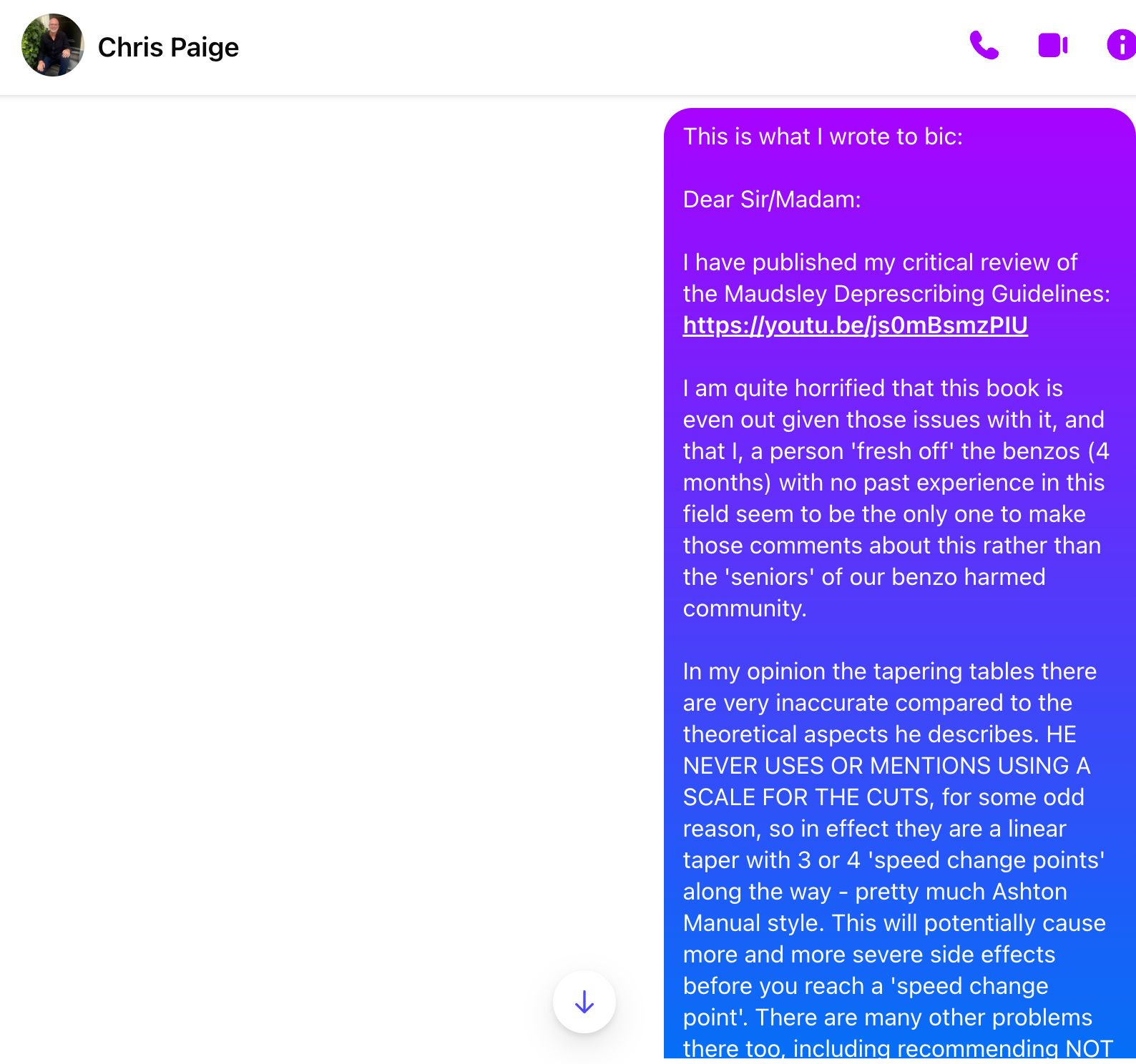
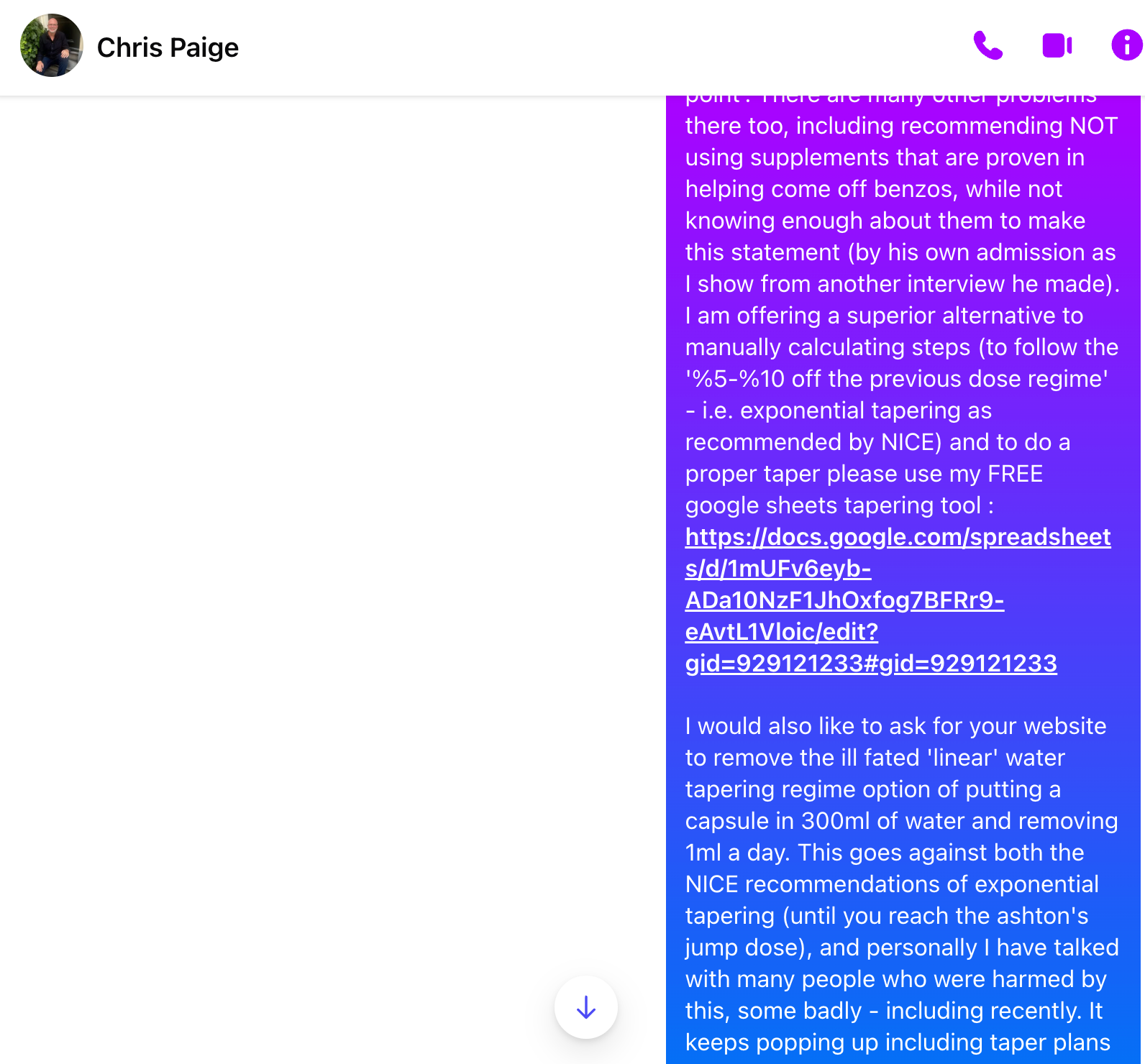
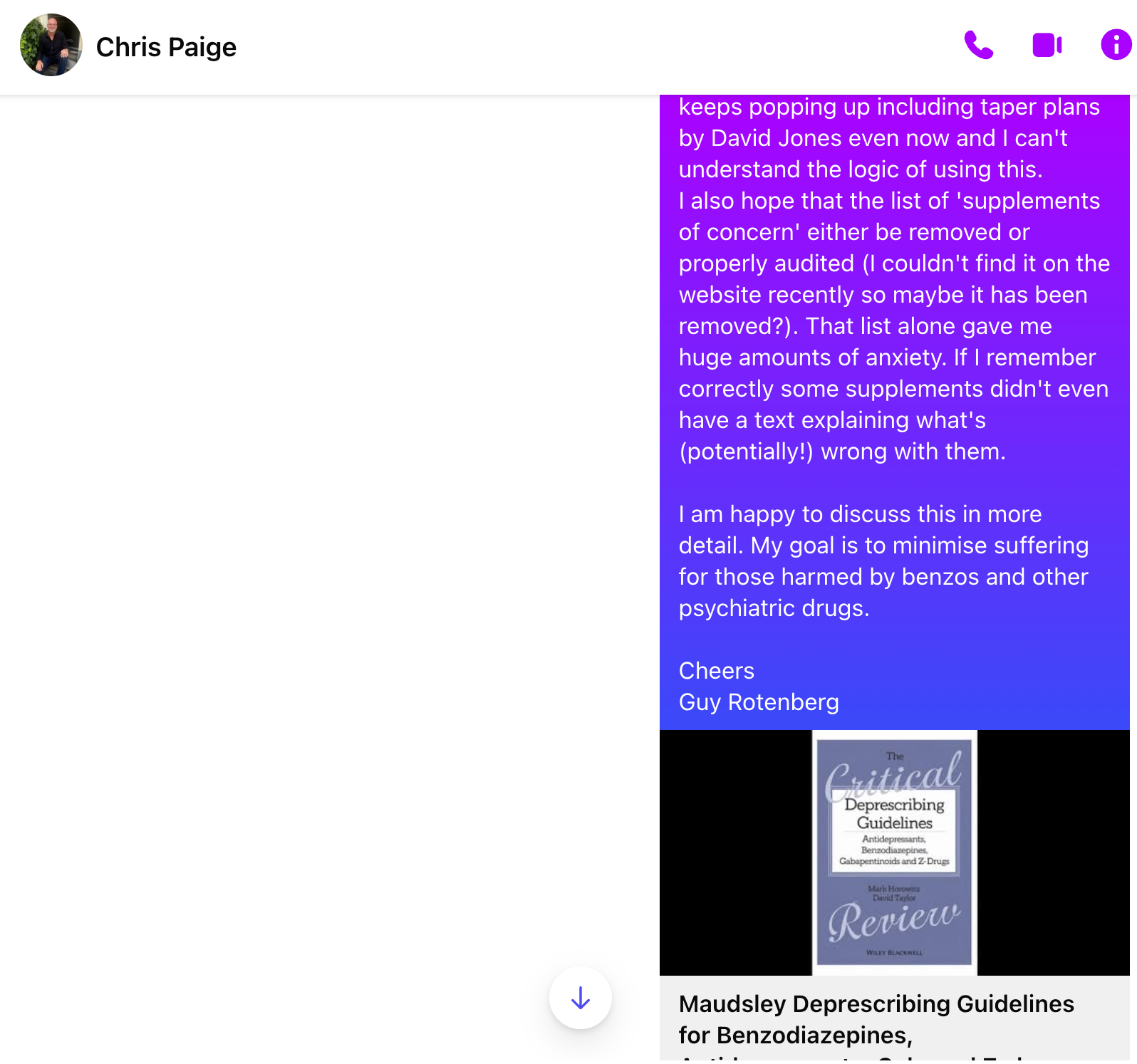
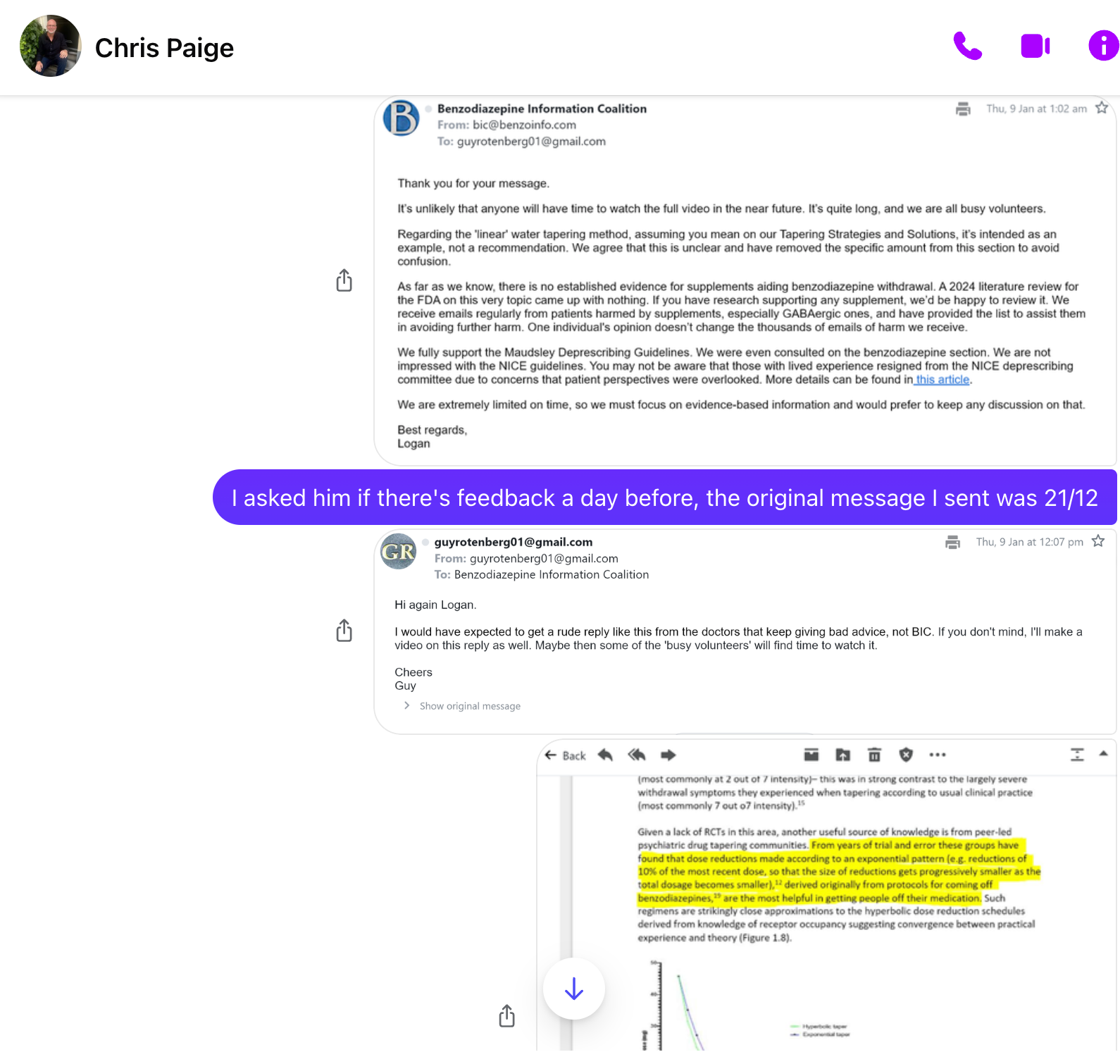
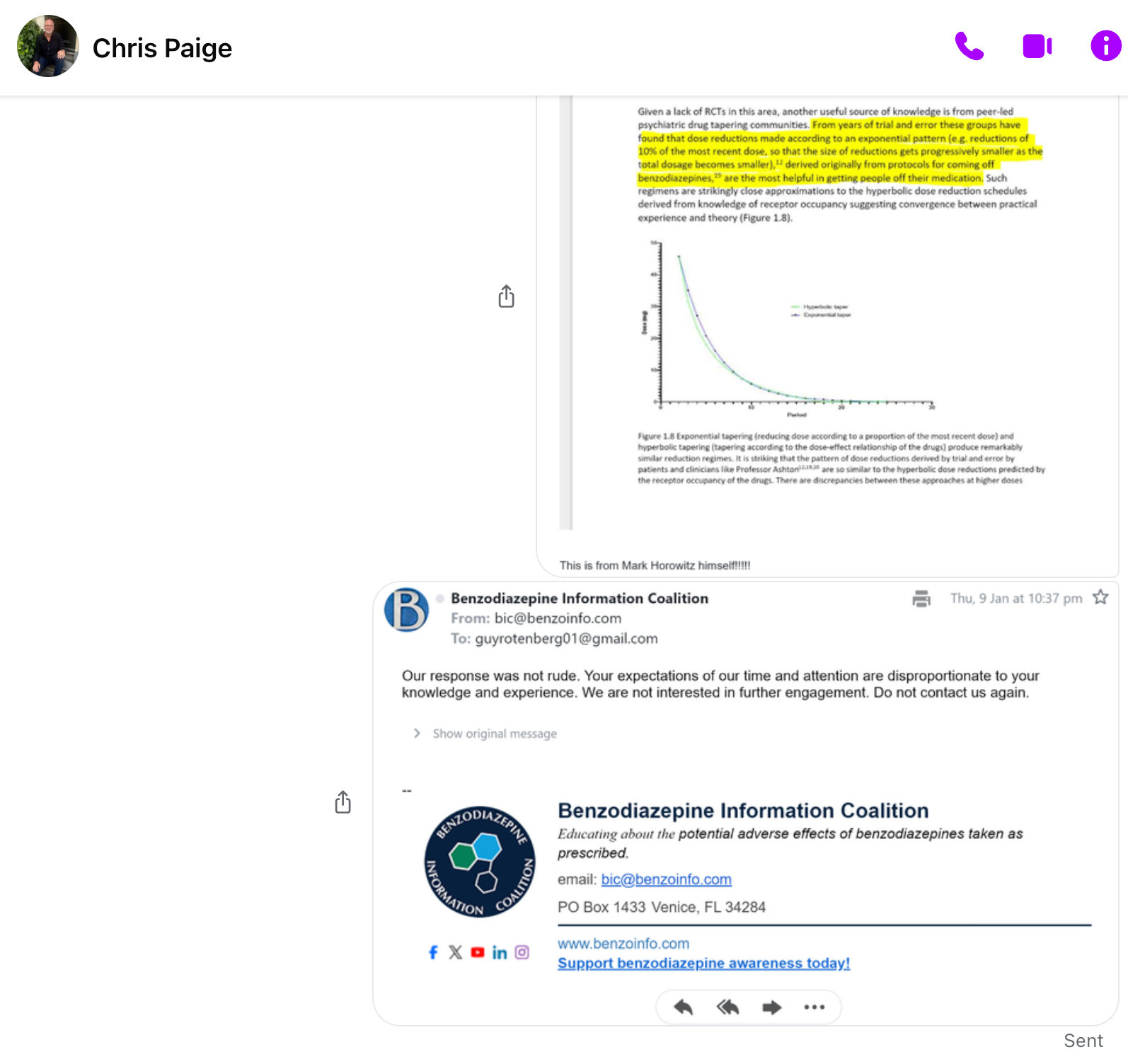
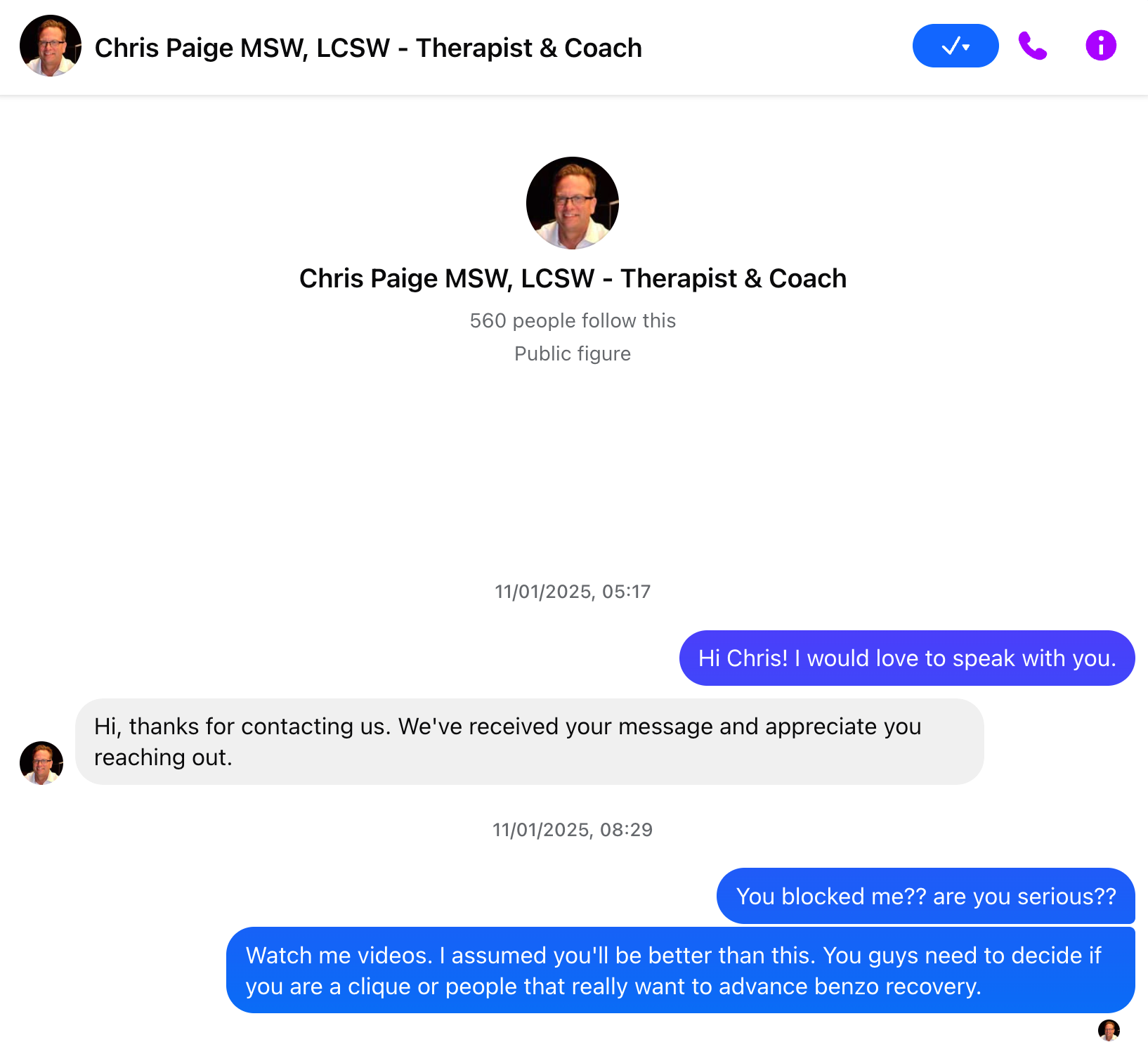
Anders Sørensen and Crossing Zero
My review of Anders Sørensen's Crossing Zero explains both what I value in the book and the concerns I believe deserve answers. In the public exchanges I retained, he responded to my review with “You sure enjoy ruining a good atmosphere, Guy” and, on another occasion when I asked for a response, “always there to party poop”. Those responses struck me as childish and, frankly, appalling. That is my opinion of the words, not a diagnosis of the person.
The second exchange was under a post celebrating US continuing-medical-education approval for a course. I acknowledged that it was a celebratory post. But if material is being used to educate clinicians, questions about its safety do not become inappropriate because they interrupt the congratulations. A good atmosphere is lovely. A substantive answer is better.
And it didn’t stop there. When I shared my articles in a withdrawal group in June 2026, Anders’s entire contribution under my post was one emoji: 😅. No question. No answer. Not one point addressed. Make of that what you want. I know what I make of it.


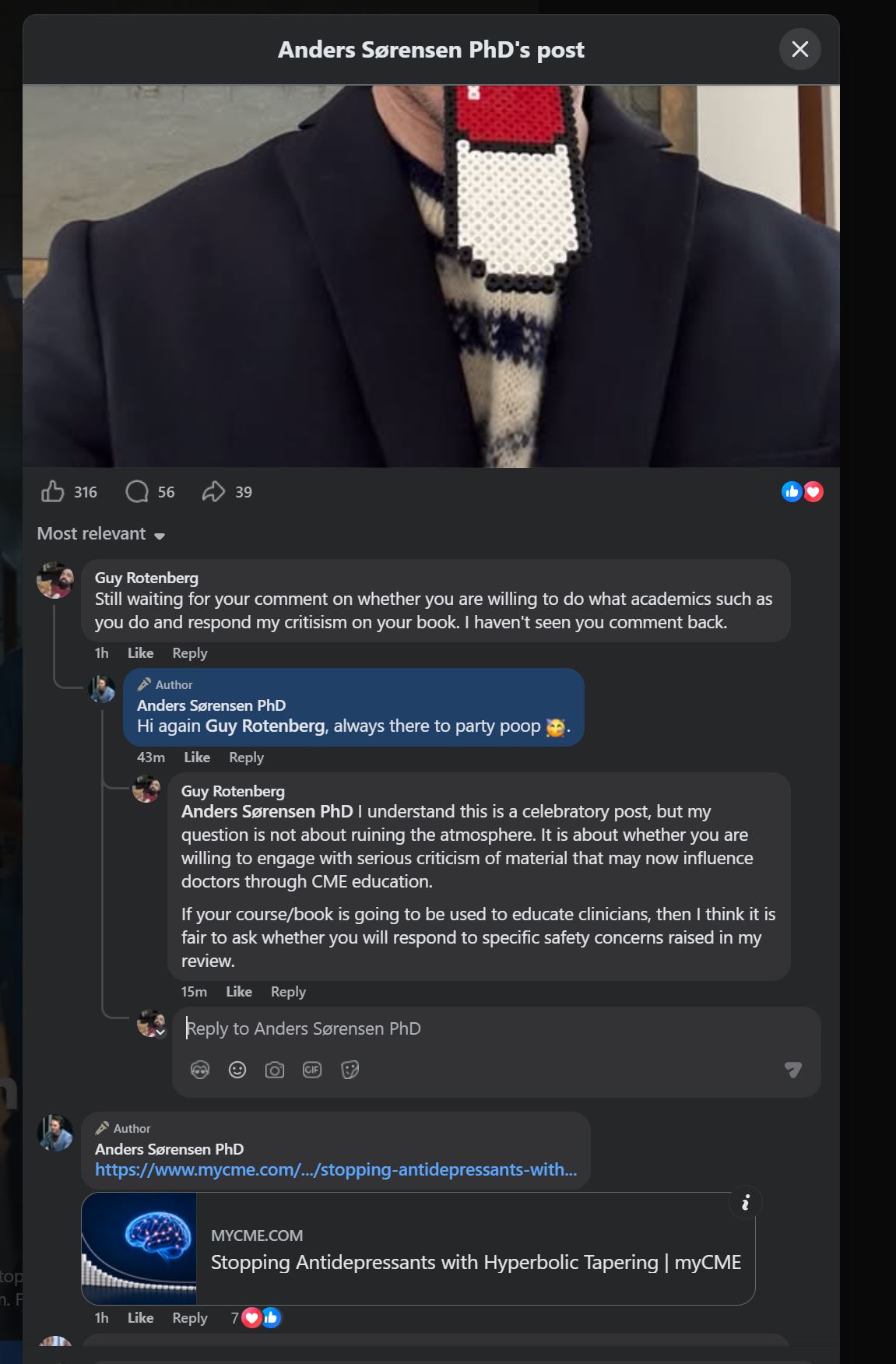
He did not only mock. In the other exchange he explained that he was describing adding a small dose of fluoxetine to help some people through the last stretch of withdrawal, said the manoeuvre needs expertise and close monitoring, and offered further help. And I corrected myself in public: I had wrongly described the book as recommending a multi-step SSRI to SNRI to Prozac cross-taper, and I withdrew that description. What he was describing is adding fluoxetine alongside the existing antidepressant and then tapering the original drug.
That correction does not soften what I think of the advice itself, and I stand behind every word of my review. “A small dose” is never turned into a number a reader can act on. Adding a second serotonergic drug on top of the first is precisely the situation where the risk of serotonin syndrome rises, and serotonin syndrome can be life-threatening. The book's own line, that serotonin syndrome “usually resolves within a few days of stopping the medication”, is in my opinion dangerously wrong for fluoxetine in particular: its active metabolite, norfluoxetine, stays in the body for one to two weeks after the last dose. If it goes wrong, you cannot simply stop and wait a day or two.
His answer put the weight on the clinician carrying out the manoeuvre. My answer is that the written guidance is what actually reaches people, and the reader I worry about is the one whose prescriber has never heard of any of this. Since expertise is the defence being offered, it is worth knowing that Anders is a clinical psychologist with a PhD, not a medical doctor. And his own systematic review accepts that the occupancy studies behind these curves were not done in people who had been on antidepressants for years, which is exactly who the curves get used on. In my opinion that combination is dangerous. These screenshots are extracts from two exchanges, not proof that he has never answered a concern somewhere else.
Read Anders's substantive reply and my correction
This separate exchange matters too: Anders explains his position and the need for expertise and monitoring; I correct my earlier description, then set out the objections I still hold. The screenshot records a debate, not a medication instruction.
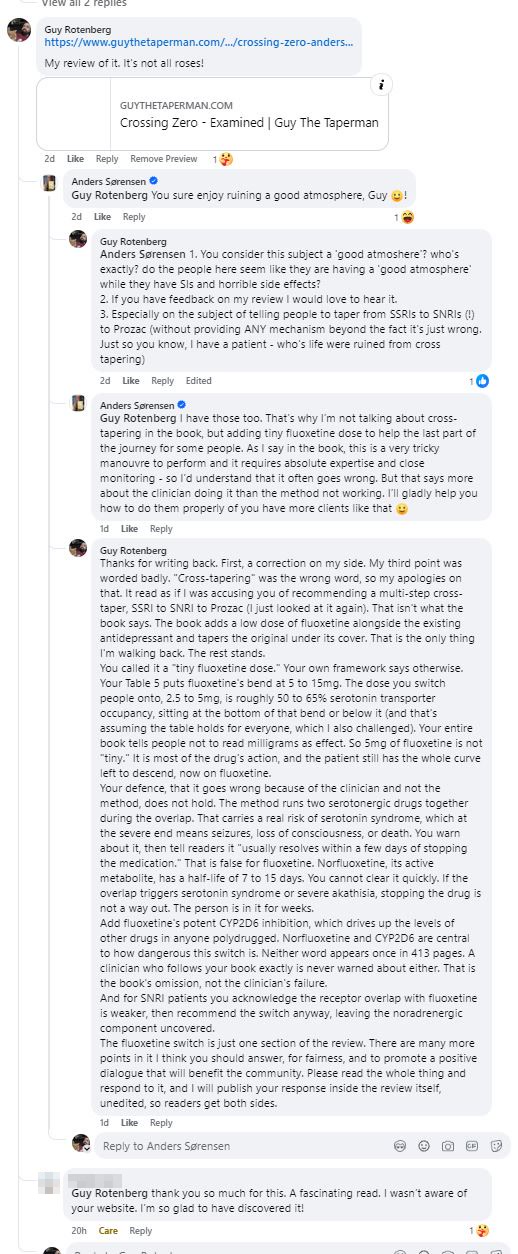
One concern in my review is the treatment of drug-switching risks, including serotonin syndrome. I will not present switching as a clever shortcut or treat interactions as a footnote. The NHS Specialist Pharmacy Service explains that using antidepressants together or in sequence can increase serotonin-syndrome risk. That general warning does not, on its own, establish that a particular author's protocol is unsafe; it does show why the details and clinical oversight matter.
Barbara Connolly and Benzo Warriors (BWC)
Benzo Warriors was one of the good places for me in 2023, and I want to say that first because it is true. When Beating Benzos threw me out over my spreadsheet, Barbara, the group's lead admin, wrote to me that I would have “a safe home in BWC”. She pinned my spreadsheet as a featured post. She told me the team thought it was terrific.
Getting there took almost a month of “team review”. A moderator wanted me to build her own taper before she would approve my post. And this is how Barbara explained why they had to be careful with my tool:
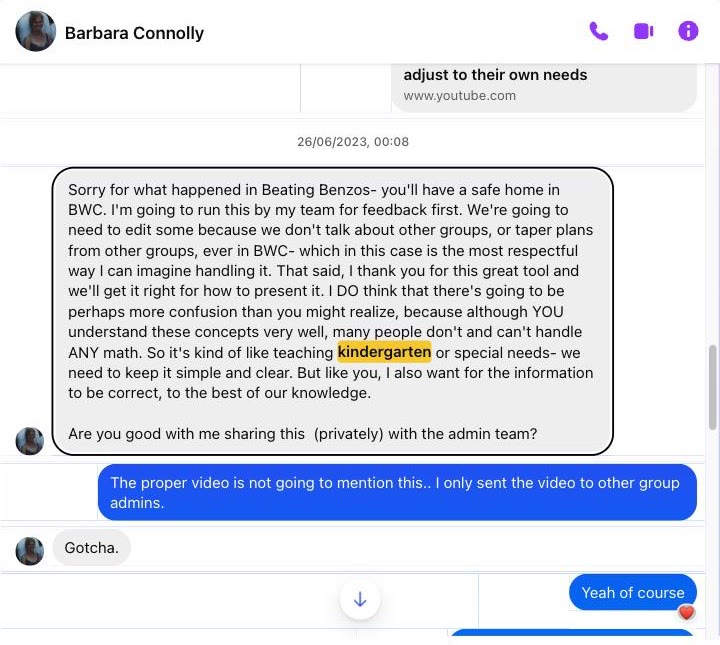
Kindergarten or special needs. That is how she described the people in her own group, people in withdrawal who can do a lot more than she gives them credit for.
In September 2024 she asked me to become a moderator. I said yes. Within a day I saw what the job was: pages of rules, and a queue of posts waiting for approval, many of them declined. Then came the lecture in the moderators' chat. I had spent an hour on a voice call with a member who needed help. That was the crime.
The BWC team chat, 28 September 2024
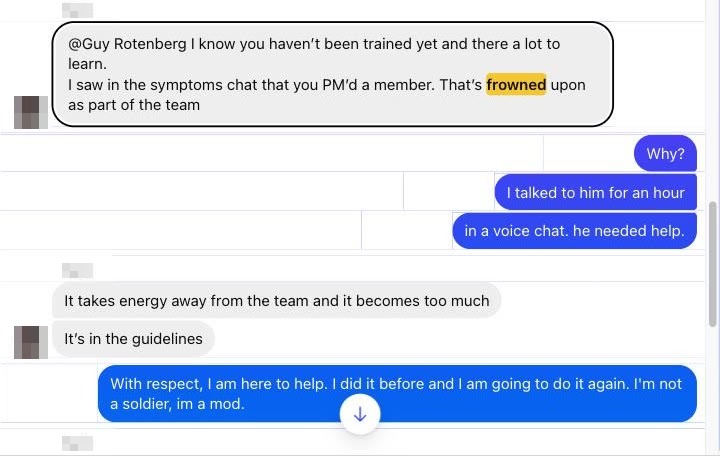
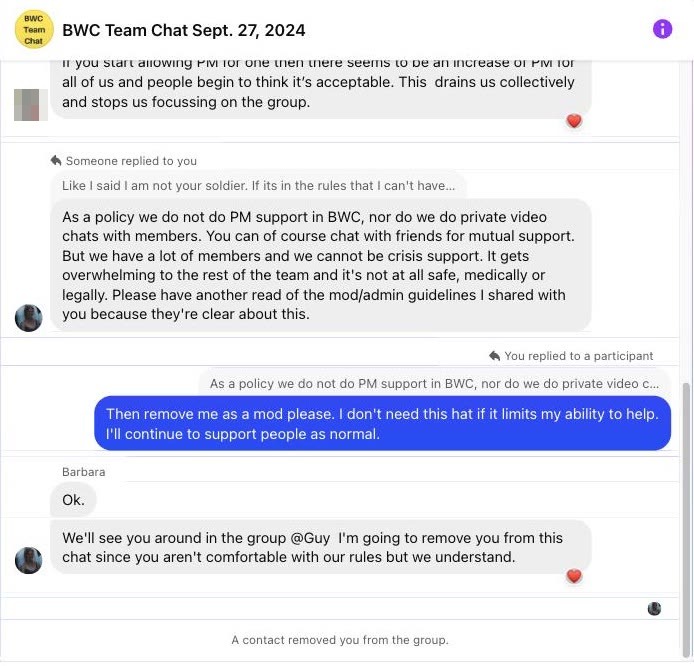
From the BWC mod/admin guidelines Barbara sent me, 27 September 2024
Talking privately to someone who is falling apart at three in the morning is exactly what saved me. Every week I talk to people in withdrawal, sometimes for two hours while they cry. A rule that tells a peer volunteer not to pick up the phone protects the group, not the person. And who are they to tell me who I can talk to on Facebook? Their group is one of many. I told them I am not their soldier and asked to be removed as a moderator. Three minutes later Barbara said she was taking me out of the chat.
In November 2024 I made a shorter video for the spreadsheet, as they had asked. It was “passed on”. When I wrote to Barbara that “your rule of not chatting with people who are suicidal is insane”, her answer was: “This is the last time I take the time to help you. Good luck Guy.”
My messages with Barbara, 2023–2024
A week later Barbara posted about tapering without a word about the spreadsheet her group had pinned and pointed people to since July 2023. I commented: “No mention of the official group spreadsheet?” My comment was removed, I got a warning for breaking the “be kind and courteous” rule, and this note:
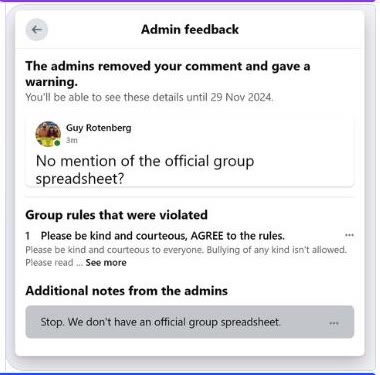
I lost it. I told Barbara she was acting like a dictator, and that I would expose anything she did that harmed the benzo community. I am not proud of the tone, and I am not hiding it. That same night I was removed from the group's members' chat, and then banned from Benzo Warriors.
A group with a history
Later, people who had been in Benzo Warriors for years told me its story. The group was founded by Michelle and Lennard, who have both since died. After them, they said, Barbara took over and the group changed: more rules, more control, more posts declined. The stories I was told about those years were sad. One admin of another group put it to me like this: “It was supportive and run like a fortune 500 company - but that was all Michelle. She didn't censor heavily that is all from Barb.” That is what I was told, not something I can check myself. To be fair, the guidelines Barbara sent me carry Michelle's name and a 2020 date, so some of those rules go back to the founders' time. What I lived through in 2024 was the version Barbara ran.
People in withdrawal should get the lowest possible level of ego and online bullying. That is the whole point of a support group. And that, I was told, is why Lennard's Benzo Warriors exists. It was not started by one unhappy member. A big group of Benzo Warriors' long-time members, its “elders”, about 50 people, were upset at what they saw as Barbara taking over the group and changing it, and they left to build a group without that control. Now read what that group did to me, in Terry Lyn's section. Very, very ironic.
Terry Lyn and Benzo Recovery & Existence (BRE)
How I ended up in that group matters. I spread my free spreadsheet around every group that would have it, and that is how I found Benzo Recovery & Existence. By then Beating Benzos had thrown me out for asking why they were handing out linear water tapers when their own manuals say the opposite. Those manuals are where I first read about proportional, exponential and hyperbolic tapering, and they warn that taking the same amount out each time hits the brain harder and harder as the dose gets lower, which means more suffering the further down you go. Benzo Recovery & Existence took the spreadsheet well. One of its admins at the time was extremely kind to me and grateful for the help. By the time any of what follows happened she was no longer an admin, for reasons I do not know. She is a private person now and is not part of this story.
I had never exchanged a single word with Terry Lyn. In October 2024 I discovered I had been banned, without warning, from Benzo Recovery & Existence, a group I loved. Nobody told me why. I wrote to Terry and to the other admins. Terry never answered me.
My message to Anthony, 23 October 2024
Because Barbara Bell was a moderator both there (BRE) and in Rosalind's group, I assumed it was her, and I said so. I was wrong, and I owe her that correction. It was not her. I had even told Terry that I thought it was Barbara Bell. No answer. About two months later, Terry said in a public post that it was her.
Barbara Bell, the person I wrongly blamed
Anthony Kalis (Benzo Recovery & Existence, BRE), another admin, apologised and let me back in. About a week later I was banned again, and this time I could not get an answer out of him at all. I wrote, and wrote, for months. Nothing. In January 2025 I found myself banned from Lennard's Benzo Warriors too. Julie Young Ingham, one of that group's admins, told me Terry was not even an admin there, and unbanned me. Three weeks later, after “a long talk” with Terry, she changed her mind: “No Terry did. But I am not overriding it.”
Lennard's Benzo Warriors, of all groups. A group that, as it was explained to me, was started by about 50 of Benzo Warriors' long-time members after they became upset at what they saw as Barbara Connolly taking over their group and changing it. I said exactly that to Julie the night I found out:
My message to Julie, 8 January 2025
What Julie wrote back
To be fair to Julie, she was honest about her reasons: she thought I needed more experience before coaching, and she disagrees with me about water tapers. Fine. Disagree with me. That is not a reason to throw someone out of a support group.
And it is not only Anthony. In these groups, admins routinely switch off their Messenger or simply never reply. Not only to me: other people tell me the same thing. I keep coming back to one question. If you do not want to talk to people, why be an admin of a support group at all? In my opinion the only answer left is ego.
Later, I was told that Terry had claimed I sent a person to hospital. I recorded it at the time, but I have not found that recording yet, so I cannot show it to you here. What I can tell you is that in October 2024 I did not have a single client. I only started coaching in December. If she said it, it is false.
Three bans, from someone I had never spoken to, and nobody ever told me directly what I was supposed to have done. That is not moderation. In my opinion it is a personal vendetta with an admin button.
Screenshots and video frames are excerpts, with context and any cropping explained beside them. Recordings are supplementary: the central accounts and selected records are available on this page. If you believe I have made a factual error, send me the specific passage and supporting information so I can examine it.
I have linked the longer reviews so you can examine the arguments, rather than take this essay as a substitute for them. You do not have to agree with every conclusion to examine the concerns.
And that standard goes both ways. If I describe somebody's work incorrectly, I should correct it. If somebody identifies a genuine problem with mine, I should examine it. Accountability cannot just be something I demand from other people.
When becoming a coach changed the welcome.
There is another part of this story I still intend to tell properly. In my experience, some other Facebook group managers became openly hostile towards me once they realised I was becoming a coach. That was how the change in their behaviour felt to me; I cannot claim to know each person's motives. I will describe the specific events in a later part of My Story, because they are directly connected to how and why I came to do this work.
Surprisingly, my experiences with managers of SSRI and other antidepressant groups have generally been much more reasonable. That is a comparison of the people and interactions I have encountered, not a verdict on every benzodiazepine group or a guarantee about every antidepressant group.
RESPECT and Reconnexion: trying to cooperate in Australia
I also approached two Australian organisations, RESPECT and Reconnexion, hoping to work with them. I experienced their responses as abrupt and felt that my attempts at cooperation were being rejected. That was a huge disappointment, particularly in a country where finding dedicated withdrawal support has been so difficult in my own experience. I will tell that story more fully too, including what I proposed and how they responded.
There is important context for RESPECT: the professor managing it told me they had no funds left. I take that seriously. It also left me questioning whether services like this receive enough government support, although I do not know the details of their funding or why it had run out. My criticism is not that they should have offered resources they did not have. It is that, even after that explanation, I was still left chasing replies and clarity. A funding shortage can explain why cooperation cannot go ahead; it does not make the lack of follow-up any less disappointing.
I found myself wondering whether burnout or exhaustion might be part of what I was encountering. That is speculation, not something I know about the people involved. They may have had constraints I could not see. But from my side, it was hard to understand: when support already feels so scarce, why did trying to contribute leave me feeling shut out? I did not expect an automatic yes. I hoped for a constructive conversation.
These experiences are part of why this work matters so much to me. I became a coach because I wanted to offer the kind of help I had needed, and do what I could to stop the next person going through the same shit. Someone seeking support should not have to navigate hostility, competing egos and group politics on top of withdrawal.
Why I will keep speaking out.
If reading this leaves you thinking I am an angry troll, and you decide not to become my client, I understand. That is not who I am, but I can see how speaking this bluntly might come across, especially if you have not lived through what brought me here. You do not owe me a booking, or even agreement.
I also know how this reads to someone who does not know me. If I were a cynic, and I did not have the receipts, I might look at one man with this many bad stories and quietly conclude that he is simply a difficult person. That is exactly why every claim here comes with the screenshot, the email or the archived page behind it. I swear on my life that all of this happened, and it is on the page for you to check yourself.
I also understand that people in withdrawal are sensitive to negativity. When your nervous system is raw, conflict is not an abstraction — reading it costs you something. That is a real reason to keep the peace, and I have thought about it more than you might expect.
The smart move, for me, would have been to say nothing. Leave the apple cart alone — even though I believe a lot of the apples in it are rotten — stay friendly with everyone, collect the referrals and build a career. I know that. I am not doing it, because I do not see this as a career. I see it as a calling: to help people who are standing where I was standing. And I will not stay quiet about things I consider dodgy, even when speaking up costs me clients who would otherwise have booked.
I want you to be safe. I do not want to be a guru nobody questions — that is the exact thing I am complaining about in this article, and it would make me a hypocrite to build it for myself. So question me too. Ask me for my reasoning, check my numbers, push back. If I cannot answer you properly, that is my problem to fix, not yours to put up with.
Given the choice between being polite about it and warning people, I will take the warning every time. Egos in this field are dangerous. People who shut the door the moment they are questioned are dangerous, because the door usually shuts on someone who is already suffering, and I have rarely seen any remorse about it. I would rather be called difficult than stay quiet about bullies.
Honestly, I would rather you “hack” my software, understand the calculations and use what helps you, even if you never pay me, rather than feel you have to like me to benefit from my work. What I want is for you to regain your health and, where appropriate, become free of the medication. Use the relevant ASAM guidance for benzodiazepines and NICE withdrawal guidance with your prescriber to inform an individual plan. These are not one-size-fits-all schedules, and no calculation can guarantee a symptom-free taper.
Choose people who put your wellbeing ahead of their fame, their ego or their bottom line. Hold me to that standard too. Your recovery matters more than whose name gets the credit.
You should never have to protect your coach's ego while trying to recover.
I know what it is like to need help and struggle to find it. I care about making that experience different for the next person. That is why I speak out.
If you want to understand the support I offer, I have written about that separately: Why work with me?