FREE TOOL
Taper Calculator — Exponential Reduction Schedules (Hyperbolic Tapering)
A taper schedule cuts a small percentage of your current dose — the dose you are on at the time of each cut — at regular intervals, so the cuts shrink as you go down. One calculator for any psychiatric medication: pick what you are tapering, and the jump dose adjusts automatically. Build a sketch below, then read why a sketch is not enough.
How the jump dose is chosen
Benzodiazepines and Z-drugs: the Ashton Manual suggests stopping (“jumping”) from about 0.5 mg diazepam-equivalent. Pick your drug from the list and the calculator converts that automatically — for example clonazepam ≈ 0.025 mg, lorazepam ≈ 0.05 mg, temazepam ≈ 1 mg. The full conversion table is in the Benzodiazepine Equivalence Table (Ashton Manual).
Antidepressants and other psychiatric medications: there is no universal jump dose — the honest rule is to get as low as you reasonably can before stopping, because the last milligrams have an outsized effect on the brain. The calculator pre-fills 1% of your current dose as a deliberately low target. Decide your real jump dose with your prescriber.
A printed schedule is not a taper
Here is the uncomfortable truth: the table above is a sketch, not your taper. The numbers that actually matter — the percentage you can tolerate, how long to hold after a rough cut, when to slow down near the bottom — are discovered only after you start, from how your body responds. Anyone selling you a fixed schedule upfront is guessing.
A real taper needs three things a static printout cannot give you: a daily symptom diary, the ability to recalculate the plan on the fly when life happens, and a documented history you can put in front of your prescriber. That is exactly what I built Guy’s Tapering Tool (GTT) to do — a Windows/Mac app with dynamic schedules (the same curve you see here, but editable step by step), a built-in diary, a benzo equivalence table, and clean printable reports. And it goes further than any calculator: GTT works out exactly what to take — how many milligrams of pill mass to weigh, or millilitres of liquid to draw, split across your doses per day — not just the mg of active ingredient.
The best way to get it: book an intake session with me. You get a personalised taper protocol built around your drug, your history and your life — and GTT Full is included FREE, set up together in the session.
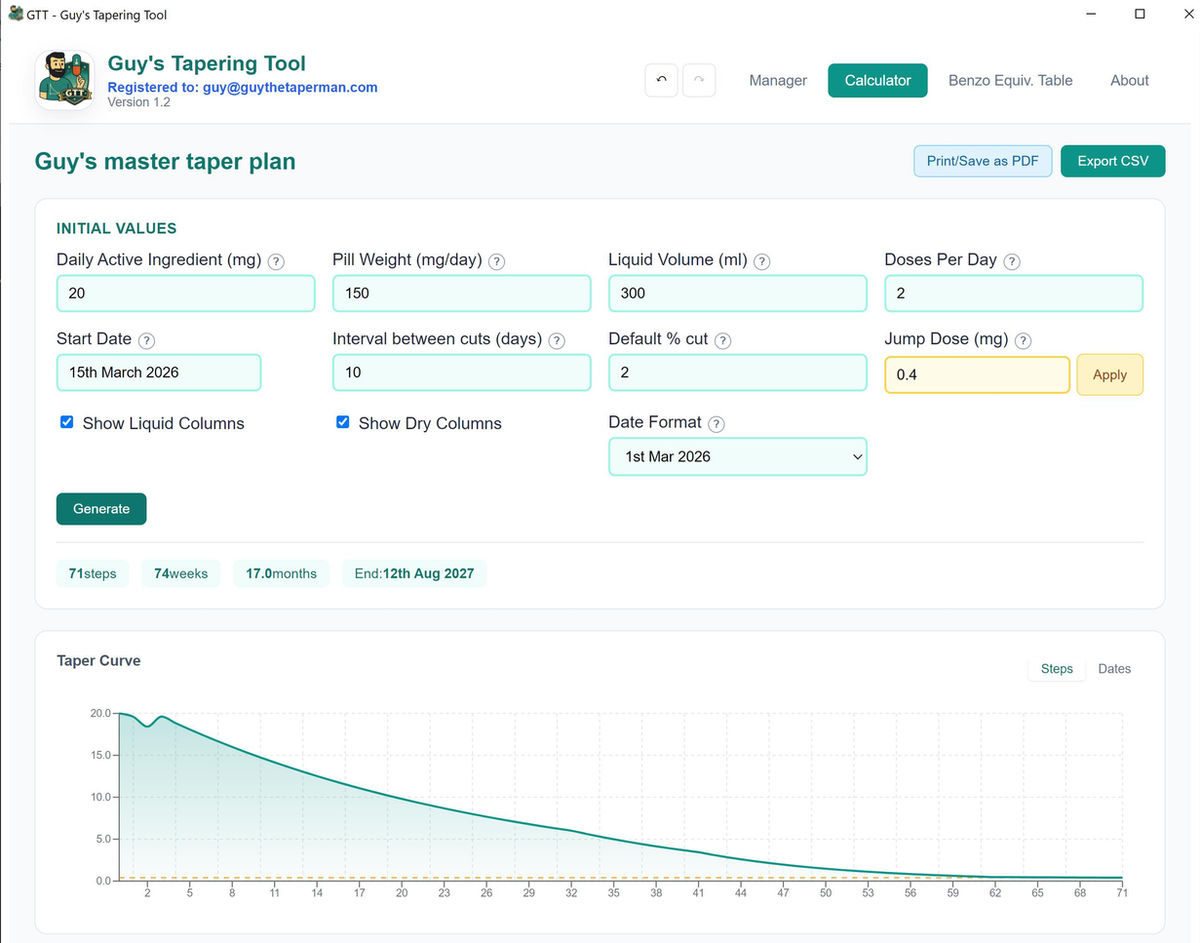
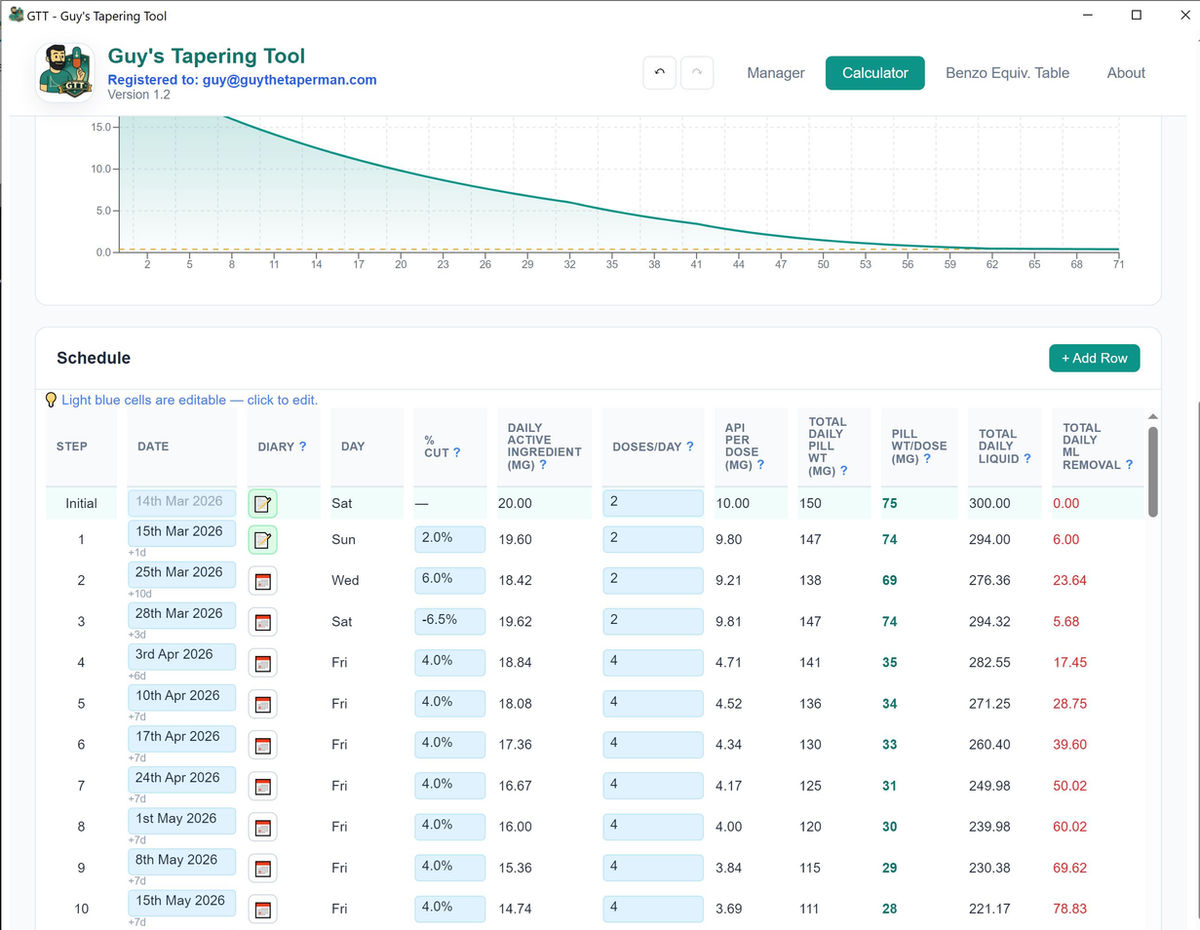
Guy’s Tapering Tool: the exact mg to weigh or ml to draw for every single dose, a dynamic editable schedule, and a symptom diary — Windows & Mac.
Book an intake — personalised plan + GTT free or see GTT on its own →
How fast should I taper?
Most modern deprescribing guidance suggests cutting roughly 5–10% of your CURRENT dose — the dose you are on at the time of each cut, not your original dose — with 1–4 weeks between cuts, and going slower near the end. The right pace is the one your body tolerates: agree it with your prescriber and adjust to symptoms.
OMG - it shows me that it will take me much more than a year or even two to fully taper! Is that correct?
I personally tapered off 2mg of clonazepam - the equivalent of 40 mg of Valium. The first 1mg was hard, and took a year of going slower and slower until I literally held the amount for 3 or 4 months, but once I found the supports that helped me taper, I was cutting even 15% every 7–10 days, with NO side effects, and finished within 4 months (jump dose was 0.025mg). This is why getting one on one help from a taper coach such as myself can be CHEAPER than doing this on your own, simply by having someone with experience helping you avoid the setbacks on the way. Furthermore, before tapering Clonazepam, I tapered Sertraline, linearly in big jumps from 200mg in 2 months with no side effects except some restless legs syndrome when I was trying to sleep for a week after I jumped. So don't assume you CAN'T taper faster - your personal speed will be revealed when you start to taper — ALWAYS start slow and in tiny amounts, and increase if you are comfortable, until you reach a rhythm that works for you WITHOUT causing you severe side effects.
Why do the cuts get smaller and smaller?
Because drug effects on the brain don’t scale in a straight line. At lower doses, each milligram occupies proportionally more receptors, so an even-sized cut hits harder the lower you go. Cutting a fixed percentage of your current dose — hyperbolic or exponential tapering — keeps each step’s impact roughly even.
What is a jump dose, and when do I stop completely?
The jump dose is the low dose you finally stop from. For benzodiazepines and Z-drugs, the Ashton Manual suggests jumping from about 0.5 mg diazepam-equivalent — this calculator converts that for your drug automatically. For antidepressants and other psychiatric drugs there is no universal jump dose: get as low as you reasonably can before stopping, because the last milligrams have an outsized effect on the brain. Decide the jump with your prescriber.
What if withdrawal symptoms hit after a cut?
Hold. Staying at your current dose until you stabilise is not failure — it is how patient-led tapering works. Once symptoms subside - that's when you know you are ready for your next cut - THIS IS CRUCIAL. And if symptoms are severe, consider returning to the LAST DOSE (not further than that) where you were stable before continuing with smaller percentage changes, and/or longer intervals. It's better NOT to delay this step - if you wait too long, for example more than a few days or up to a week after the symptoms first appear, the receptors might have already started to adapt and going back might not make a change or even make you feel worse as you confuse your system. So PLEASE don't feel like you must be a hero - go back a step and wait for things to settle.
Should my doctor manage my taper?
Ideally, yes — the best outcomes happen when you have a prescriber on your side who understands slow, percentage-based tapering. In practice, most were never taught how to take people OFF these drugs. Recently a client sent me a voice recording of her (now ex-) psychiatrist — a serious, well-known psychiatrist — admitting he had no idea what was going on: a few years ago there were no withdrawals in the literature, now there are, and she was welcome to look for someone else. He simply gave up on her. The next psychiatrist told her she could come off her SSRI 20 → 15 → 10 → 5 → 0 mg. That is a crash, not a taper. So keep your prescriber in the loop, but do not outsource the pacing to anyone who has not studied withdrawal: your symptoms set the pace, and a good doctor respects that. Part of my job as a peer coach is helping you advocate for the slow taper you deserve — or helping you find a more taper-informed prescriber.
Keep reading
→ Benzodiazepine Equivalence Table (Ashton Manual)
→ Psychiatric Drug Withdrawal — Symptoms, Causes & What Helps
→ Crossing Zero: The Tail and the Jump — how to finish a taper
Want help applying this safely?
I went through this myself and now help others do it with a plan, not guesswork. The first 20-minute call is free — no obligation.
Book a free discovery call → or read how I work →If you are in crisis, contact your local emergency services, or find a helpline for your country at findahelpline.com (Australia: Lifeline 13 11 14 · US & Canada: call or text 988 · UK & ROI: Samaritans 116 123).
© Guy Rotenberg · guythetaperman.com · guy@guythetaperman.com